
For more than a century, IBM has remained one of the most influential names in enterprise technology. While many technology companies have risen and fallen over the decades, IBM has consistently reinvented itself to meet changing market demands. Today, the company is no longer defined solely by mainframe computers or enterprise hardware. Instead, it has positioned itself as a global leader in artificial intelligence, hybrid cloud computing, enterprise software, cybersecurity, and quantum computing.
With organizations accelerating digital transformation, IBM has strengthened its presence by helping businesses modernize infrastructure, automate workflows, and leverage AI for smarter decision-making. Combined with strategic acquisitions and continued investment in research, the company remains one of the most recognized technology brands worldwide.
🔑 Key Takeaways
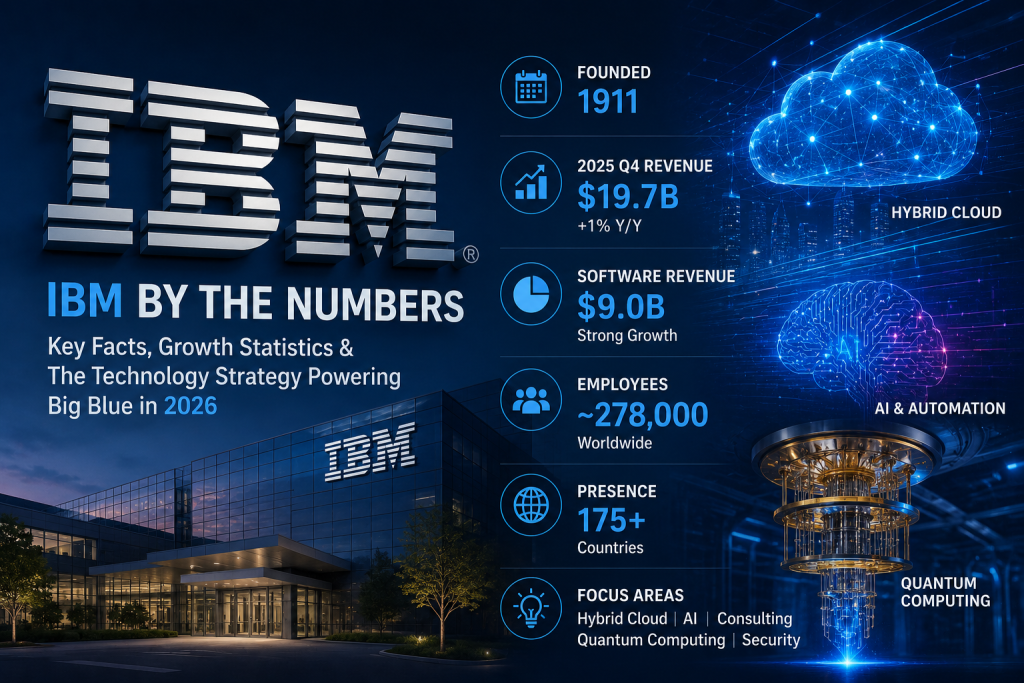
| Topic | Details |
|---|---|
| Founded | 1911 |
| Headquarters | Armonk, New York, USA |
| Core Focus | Hybrid Cloud, AI, Consulting, Quantum Computing |
| 2025 Q4 Revenue | USD 19.7 Billion |
| Fastest Growing Segment | Software |
| Future Investment | Quantum Computing & Enterprise AI |
A Legacy of Reinvention
IBM has built its reputation by adapting to every major shift in technology. From mechanical tabulating systems to personal computing, enterprise software, cloud computing, and now artificial intelligence, the company has repeatedly transformed its business model to stay competitive.
Today, IBM’s strategy focuses on helping enterprises solve complex business challenges through intelligent automation, cloud-native technologies, cybersecurity, and AI-powered solutions.
Rather than competing directly in consumer technology, IBM concentrates on enterprise customers across healthcare, banking, manufacturing, government, retail, telecommunications, and financial services.
IBM’s Financial Performance Reflects Strategic Growth
IBM delivered a strong financial performance during 2025, outperforming expectations across several business divisions. Fourth-quarter revenue reached USD 19.7 billion, supported by continued momentum in software, consulting, and infrastructure businesses. The company’s software division generated approximately USD 9 billion in quarterly revenue, while consulting contributed USD 5.3 billion, reflecting steady enterprise demand for digital transformation services. Infrastructure revenue also experienced significant growth, driven by strong demand for IBM’s Z Systems mainframe platform.
The company’s performance demonstrates its successful transition from a traditional hardware manufacturer into a software-led enterprise technology provider.
IBM’s Core Business Segments
IBM operates through several complementary business divisions that together form its enterprise technology ecosystem.
| Business Segment | Primary Focus |
| Software | AI, Automation, Data & Hybrid Cloud |
| Consulting | Digital Transformation & Business Services |
| Infrastructure | Servers, Storage & Mainframes |
| Financing | Enterprise Financing Solutions |
| Research | Artificial Intelligence & Quantum Computing |
This diversified structure allows IBM to provide complete end-to-end technology solutions for enterprise customers worldwide.
Artificial Intelligence Is Driving IBM’s Future
Artificial intelligence has become one of IBM’s primary growth engines.
The company’s AI portfolio, led by its enterprise AI platform, focuses on helping organizations automate operations, improve productivity, analyze business data, and develop industry-specific AI applications.
Unlike consumer-focused AI platforms, IBM emphasizes responsible AI, governance, transparency, and enterprise-grade security.
Organizations across finance, healthcare, manufacturing, and government sectors continue adopting IBM’s AI technologies to optimize operations while maintaining regulatory compliance.
Hybrid Cloud Remains a Strategic Priority
Cloud computing continues to be one of IBM’s largest long-term growth opportunities.
Through its hybrid cloud strategy, IBM enables businesses to integrate private cloud, public cloud, and on-premise infrastructure into unified environments.
This flexibility allows enterprises to modernize existing systems without completely replacing legacy infrastructure.
The acquisition of Red Hat significantly strengthened IBM’s cloud capabilities and accelerated enterprise adoption of open hybrid cloud architectures.
IBM Is Investing Billions in Quantum Computing
Quantum computing represents another major pillar of IBM’s long-term strategy.
The company recently announced plans to invest more than USD 10 billion over five years to accelerate the development of large-scale quantum computing technologies. IBM aims to build one of the world’s first practical, fault-tolerant quantum computing platforms capable of solving highly complex scientific and commercial problems.
Today, hundreds of enterprises, universities, startups, and government organizations already use IBM Quantum systems for research in chemistry, materials science, optimization, and cryptography.
As quantum computing matures, IBM expects the technology to become a key driver of enterprise innovation.
Why Enterprises Continue Choosing IBM
Several factors continue to strengthen IBM’s competitive position:
- Extensive enterprise technology expertise
- Strong focus on hybrid cloud environments
- Advanced artificial intelligence capabilities
- Leadership in quantum computing research
- Comprehensive cybersecurity solutions
- Global consulting services
- Long-standing relationships with Fortune 500 organizations
These strengths enable IBM to remain highly relevant despite intense competition from cloud providers and enterprise software companies.
Frequently Asked Questions
What does IBM specialize in today?
IBM primarily focuses on hybrid cloud computing, enterprise artificial intelligence, consulting services, cybersecurity, infrastructure solutions, and quantum computing technologies.
Is IBM still a hardware company?
While IBM continues to offer enterprise infrastructure solutions and mainframe systems, its business has shifted significantly toward software, consulting, AI, and cloud services.
Why is IBM investing heavily in quantum computing?
Quantum computing has the potential to solve highly complex computational problems that are beyond the capabilities of today’s classical computers. IBM views quantum technology as one of the next major frontiers in enterprise computing.
What industries use IBM solutions?
IBM serves organizations across healthcare, banking, insurance, manufacturing, telecommunications, retail, government, energy, and financial services.
Final Thoughts
IBM’s ability to evolve over more than a century is one of the primary reasons it remains a global technology leader. By combining enterprise AI, hybrid cloud, consulting expertise, and ambitious investments in quantum computing, the company has positioned itself for the next era of digital transformation.
As businesses continue modernizing operations and embracing intelligent technologies, IBM’s diversified strategy places it at the center of enterprise innovation. While the technology landscape continues to evolve rapidly, IBM’s focus on solving complex business challenges ensures it remains one of the industry’s most influential and resilient organizations.