
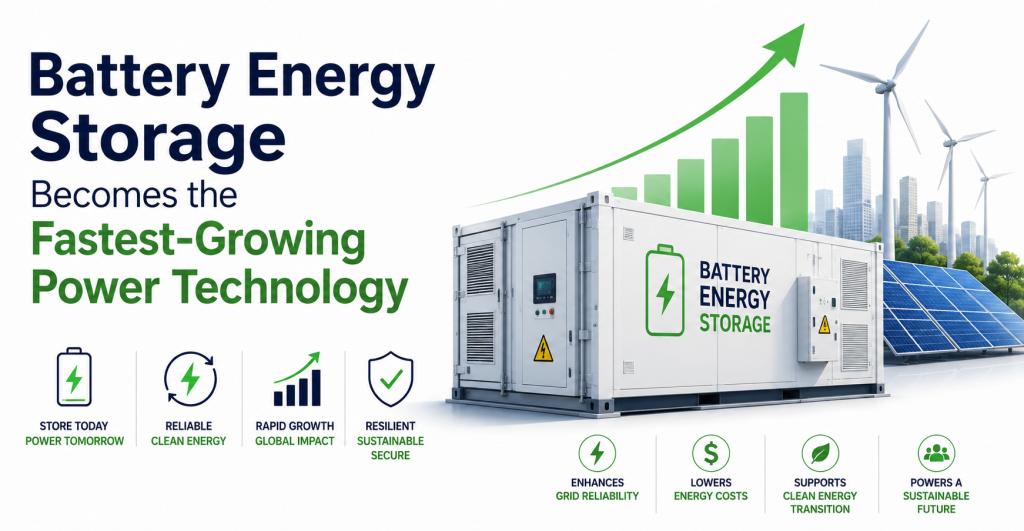

Battery Energy Storage Systems (BESS) are transforming the global electricity sector as governments, utilities, and private investors accelerate the transition toward cleaner, more resilient energy infrastructure. Once considered a supporting technology, battery storage has become a critical component of modern power systems, enabling renewable energy integration, improving grid stability, and strengthening energy security.
According to the International Energy Agency (IEA), battery storage was the fastest-growing power technology in the world in 2025. Global deployments reached a record 108 gigawatts (GW) of new battery storage capacity, representing a 40% increase compared with 2024. The agency also reported that global installed battery storage capacity is now 11 times higher than it was in 2021, highlighting the remarkable pace of industry expansion.
Renewable Energy Growth Is Driving Storage Demand
As countries continue expanding solar and wind power generation, battery storage is becoming indispensable for balancing electricity supply and demand. Renewable energy production naturally fluctuates with weather conditions, making storage systems essential for capturing excess electricity during peak generation and delivering it when demand increases.
The rapid deployment of renewable energy is creating unprecedented opportunities for battery storage developers, equipment manufacturers, utilities, and infrastructure investors. Grid operators are increasingly deploying large-scale battery projects to improve flexibility, reduce transmission congestion, and provide reliable electricity during periods of high demand.
Utility-Scale Projects Lead Global Expansion
Large utility-scale battery installations remain the primary growth driver worldwide. The IEA estimates that approximately 80% of all new battery storage capacity added in 2025 came from utility-scale projects, while the remaining installations were deployed across commercial buildings, industrial facilities, and residential properties.
China continues to dominate the global battery storage market, accounting for approximately 60% of worldwide battery storage additions in 2025. The United States and Europe remain the second and third largest deployment markets, while Australia and several Middle Eastern countries have emerged as rapidly expanding regions for battery investments.
Lithium Iron Phosphate Batteries Dominate the Market
Technological innovation continues to improve battery performance while reducing costs. The IEA reports that Lithium Iron Phosphate (LFP) batteries represented around 90% of global battery storage deployments in 2025, largely due to their lower cost, longer operating life, and enhanced safety compared with alternative battery chemistries.
Researchers are simultaneously advancing next-generation technologies—including sodium-ion, solid-state, iron-air, and flow batteries—that could further diversify the energy storage market over the coming decade.
Artificial Intelligence and Data Centers Create New Opportunities
Beyond renewable energy, rising electricity demand from artificial intelligence applications and hyperscale data centers is creating a significant new market for battery storage. Modern digital infrastructure requires uninterrupted electricity, prompting operators to invest heavily in battery-based backup systems and grid-support technologies.
The IEA also noted that battery-based uninterruptible power supply (UPS) capacity, widely used in data centers, increased to approximately 45 GW of new capacity during 2025, reflecting growing demand for resilient digital infrastructure.
Sustainability and Recycling Gain Momentum
As deployment accelerates, sustainability remains a major industry priority. Manufacturers are investing in battery recycling technologies that recover valuable materials such as lithium, nickel, cobalt, and graphite, reducing dependence on newly mined resources while supporting circular economy initiatives.
Industry leaders are also expanding domestic manufacturing capacity across North America, Europe, and Asia to strengthen supply chains and reduce geopolitical risks associated with critical minerals.
Key Battery Energy Storage Statistics
- 108 GW of new battery storage capacity was installed globally in 2025, marking a 40% year-over-year increase.
- Global installed battery storage capacity is now 11× higher than in 2021.
- Around 80% of new battery deployments in 2025 were utility-scale projects.
- Lithium Iron Phosphate (LFP) batteries accounted for approximately 90% of deployments worldwide.
- China contributed about 60% of global battery storage additions in 2025.
- Battery-based UPS installations for data centers grew to approximately 45 GW in 2025.
Outlook
Battery energy storage is expected to remain one of the fastest-growing clean energy technologies throughout the coming decade. Supported by expanding renewable energy capacity, rising electricity consumption, AI-driven infrastructure, and favorable government policies, the sector is becoming a cornerstone of the global energy transition. As innovation continues and investment increases, battery storage will play a vital role in delivering cleaner, more reliable, and more resilient power systems worldwide.