
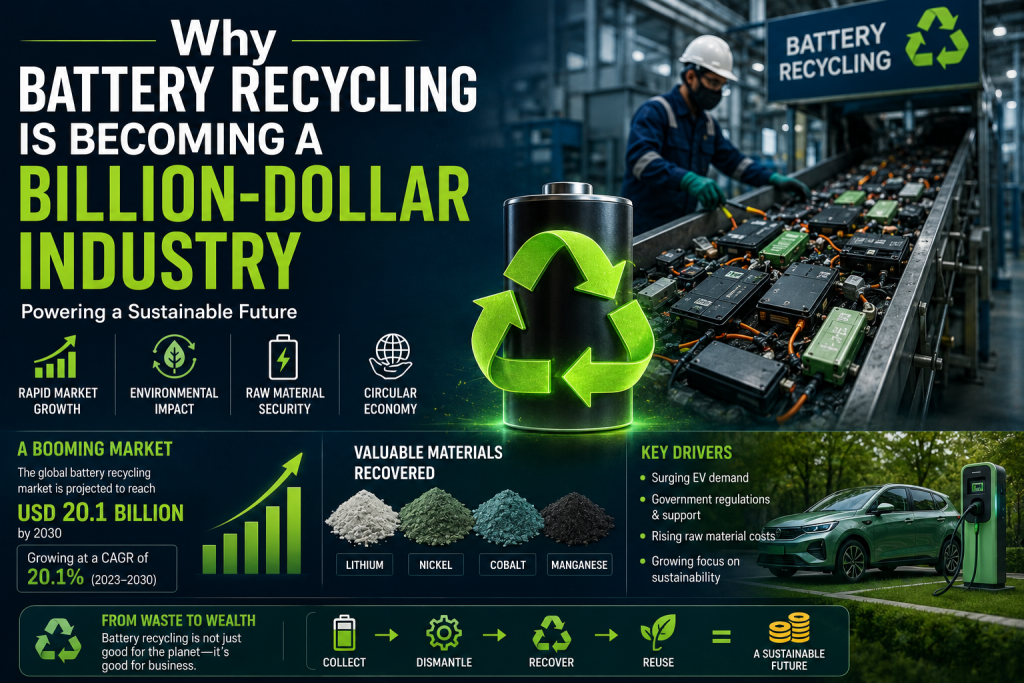

The global shift toward electric vehicles (EVs), renewable energy, and portable electronics has created an unprecedented demand for lithium-ion batteries. While these batteries are essential for a cleaner and more sustainable future, they also present a growing challenge once they reach the end of their lifespan. This challenge has given rise to one of the fastest-growing sectors in the clean energy economy—battery recycling.
Instead of treating used batteries as waste, governments and industries now recognize them as valuable sources of critical minerals such as lithium, cobalt, nickel, copper, and graphite. These materials can be recovered, processed, and reused to manufacture new batteries, reducing dependence on mining and supporting a circular economy.
As millions of electric vehicles enter roads worldwide, battery recycling is quickly becoming a billion-dollar industry with enormous economic and environmental potential.
Why Battery Recycling Matters
Modern lithium-ion batteries contain expensive and limited natural resources. Extracting these materials through mining requires significant energy, water, and land while creating environmental challenges.
Battery recycling offers a sustainable alternative by recovering valuable materials from used batteries. The recovered metals can be refined and used to manufacture new batteries, reducing both production costs and environmental impact.
As battery demand continues to increase, recycling is becoming an essential part of the global clean energy supply chain.
Electric Vehicles Are Fueling Growth
The rapid adoption of electric vehicles is the biggest driver behind battery recycling.
Every EV battery has a useful life of approximately 8 to 15 years. As early generations of electric vehicles begin reaching the end of their battery life, millions of batteries will require safe disposal, refurbishment, or recycling.
This growing supply of retired batteries represents both an environmental responsibility and a valuable business opportunity.
Valuable Materials Can Be Reused
Lithium-ion batteries contain several high-value materials, including:
- Lithium
- Nickel
- Cobalt
- Copper
- Graphite
- Aluminum
Instead of mining these resources repeatedly, recycling allows manufacturers to recover and reuse them in new battery production.
This reduces raw material costs while improving supply chain security.
Technology Is Making Recycling More Efficient
Battery recycling has advanced significantly over the past decade.
Modern recycling facilities now use automated dismantling systems, artificial intelligence, and advanced chemical processes to recover materials more efficiently than ever before.
New technologies can recover up to 95% of valuable battery metals while using less energy than traditional mining operations.
These innovations are improving profitability and making recycling increasingly attractive for investors and manufacturers alike.
Environmental Benefits
Battery recycling provides several environmental advantages.
It helps:
- Reduce mining activities
- Lower greenhouse gas emissions
- Prevent hazardous battery waste
- Conserve natural resources
- Reduce landfill pollution
- Support sustainable manufacturing
Producing battery materials from recycled sources generally requires far less energy than extracting virgin minerals.
As countries work toward climate goals, battery recycling is becoming an important part of sustainable industrial development.
Second-Life Battery Applications
Not every battery reaching the end of its vehicle life needs immediate recycling.
Many EV batteries still retain 70–80% of their original capacity after being removed from vehicles.
These batteries can be repurposed for:
- Solar energy storage
- Wind power storage
- Residential backup systems
- Commercial energy storage
- Emergency power solutions
After serving these second-life applications, the batteries can then be recycled to recover valuable materials.
Business Opportunities Continue to Expand
Battery recycling is creating opportunities across multiple industries.
Growing demand is encouraging investment in:
- Recycling facilities
- Battery collection networks
- Material recovery technologies
- Battery transportation services
- Second-life energy storage
- Research and innovation
As governments continue promoting electric mobility and renewable energy, demand for battery recycling services is expected to grow steadily over the coming decades.
Global Battery Recycling Statistics
| Statistic | Value |
|---|---|
| Global EV sales | 17+ million vehicles (2024) |
| Share of global car sales that were electric | Over 20% |
| Lithium-ion battery demand from EVs | Around 85% |
| Recoverable battery materials | Up to 95% |
| Average EV battery lifespan | 8–15 years |
| Expected retired EV batteries annually | 10+ million tons by 2040 |
| Current global lithium-ion battery recycling rate | Less than 10% |
| Battery capacity remaining after vehicle use | 70–80% |
Challenges Ahead
Despite its enormous potential, battery recycling still faces several challenges.
Battery designs vary among manufacturers, making dismantling more complex. Safe transportation, standardized recycling processes, and expanding collection infrastructure remain important priorities.
However, continuous technological improvements and increasing public awareness are helping overcome these obstacles.
As more batteries enter the recycling stream, economies of scale will further reduce costs and improve efficiency.
Future Outlook
Battery recycling is set to become one of the most important industries supporting the global clean energy transition. The rapid expansion of electric vehicles, renewable energy systems, and portable electronics ensures that demand for battery materials will continue to rise.
Rather than relying solely on mining finite natural resources, industries are increasingly embracing recycling as a sustainable solution. Recovering valuable materials from used batteries not only reduces environmental impact but also strengthens supply chains and creates new economic opportunities.
In the coming years, battery recycling will play a central role in building a circular economy where valuable resources remain in use for longer, waste is minimized, and clean energy technologies become even more sustainable. As innovation continues and recycling infrastructure expands worldwide, this industry is expected to remain one of the most promising sectors of the global green economy.