

Digital Identity Is Reshaping the Global Digital Economy
Digital identity has become one of the most important foundations of the modern digital economy. As governments, financial institutions, healthcare providers, and technology companies continue to expand online services, secure identity verification has emerged as a critical requirement for protecting users, preventing fraud, and enabling trusted digital interactions.
The rapid growth of digital banking, e-commerce, remote work, telemedicine, and online government services has significantly increased the demand for reliable digital identity solutions. Organizations are investing in identity verification platforms that combine biometric authentication, artificial intelligence, document verification, and multi-factor authentication to deliver secure and seamless customer experiences.
Governments Accelerate National Digital Identity Programs
Governments around the world are expanding national digital identity initiatives to simplify access to public services and strengthen cybersecurity. Digital identity systems enable citizens to securely access healthcare, taxation, social benefits, education, voting services, and other government platforms without repeatedly submitting physical documents.
Countries across Asia, Europe, Africa, and the Middle East continue to modernize identity infrastructure by adopting digital credentials and electronic verification systems. These initiatives are helping reduce administrative costs while improving service delivery and supporting financial inclusion.
Financial Services Lead Digital Identity Adoption
Banks and fintech companies remain among the largest adopters of digital identity technologies. Financial institutions rely on electronic Know Your Customer (eKYC) processes and digital identity verification to comply with regulatory requirements while reducing onboarding time and minimizing identity fraud.
Consumers increasingly expect faster account opening, secure online transactions, and frictionless authentication across mobile banking applications. As a result, organizations are replacing traditional password-based systems with biometric verification, passkeys, facial recognition, fingerprint authentication, and behavioral analytics.
Artificial Intelligence Improves Identity Verification
Artificial intelligence is transforming digital identity management by improving document verification accuracy, detecting fraudulent identities, and identifying suspicious user behavior in real time. AI-powered verification systems can analyze government-issued identification documents, perform facial matching, and identify deepfake attacks more effectively than conventional verification methods.
The growing sophistication of cybercriminals has encouraged organizations to adopt continuous identity verification rather than relying solely on one-time authentication during account creation.
Businesses Invest in Identity Security
Beyond government and banking, industries including healthcare, telecommunications, education, travel, insurance, and retail are expanding investments in identity verification technologies. Organizations recognize that secure digital identity not only protects sensitive customer information but also improves user trust and regulatory compliance.
Businesses are increasingly integrating identity management platforms with cloud infrastructure, enabling employees and customers to securely access digital services from virtually anywhere while reducing operational complexity.
Privacy and Cybersecurity Remain Top Priorities
As digital identity adoption expands, protecting personal information has become equally important. Organizations are implementing privacy-first identity frameworks that allow users greater control over how their personal information is stored, shared, and verified.
Emerging concepts such as decentralized identity and verifiable credentials are gaining attention because they reduce dependence on centralized databases while giving individuals more ownership of their digital identities.
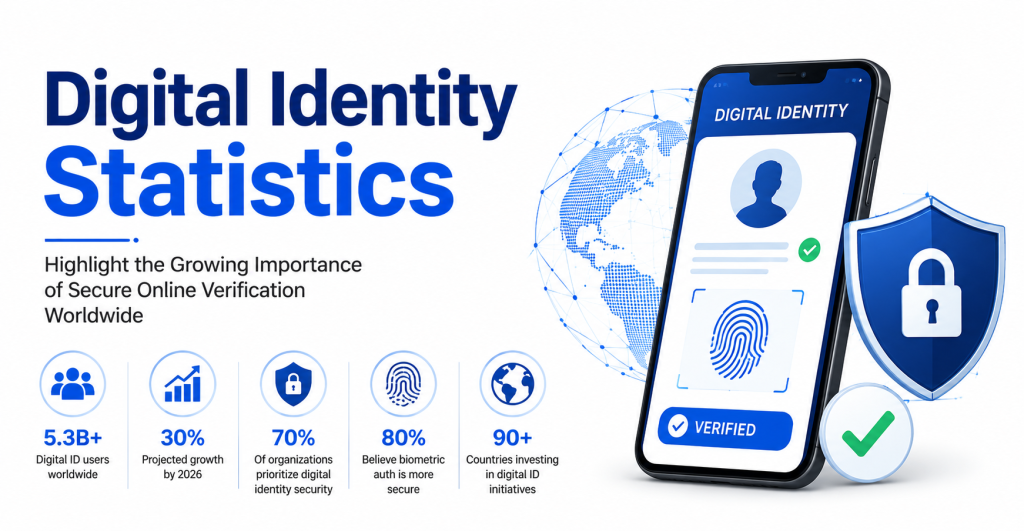
Key Digital Identity Statistics
- More than 850 million people use digital ID systems supported by the World Bank’s Identification for Development (ID4D) initiative across multiple countries.
- According to the World Bank, approximately 850 million people worldwide still lack an official proof of identity, highlighting a major opportunity for digital identity expansion.
- The FIDO Alliance reports continued global growth in passkey adoption as organizations move toward passwordless authentication.
- Identity theft and account takeover remain among the fastest-growing forms of cybercrime, increasing enterprise investment in digital identity verification.
- Financial services continue to represent one of the largest markets for eKYC and digital identity technologies.
- Governments worldwide are expanding national digital identity programs to improve public service delivery and financial inclusion.
Future Outlook
Digital identity is expected to become a central component of the global digital economy over the next decade. Continued advances in artificial intelligence, biometrics, passwordless authentication, decentralized identity, and cloud security are reshaping how individuals verify their identities online. As digital transformation accelerates across every major industry, trusted digital identity solutions will play a critical role in strengthening cybersecurity, improving customer experiences, and enabling secure digital services at scale.
Organizations that invest in modern identity infrastructure today will be better positioned to meet evolving regulatory requirements, reduce fraud risks, and build greater trust in an increasingly connected world.