
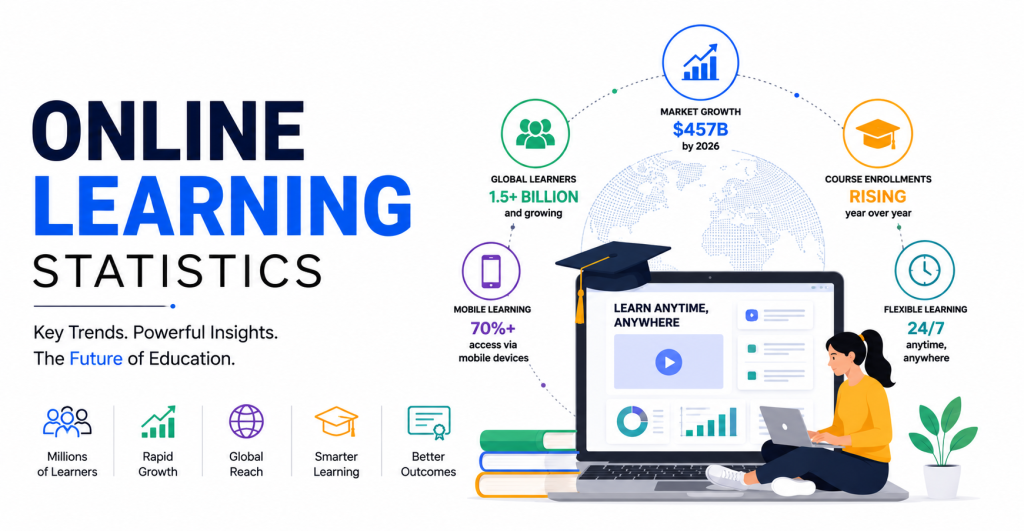

There was a time when learning meant sitting inside a classroom, following a fixed schedule, and relying on printed textbooks. Today, education looks very different. A student can attend a university lecture from another country, a working professional can earn a new certification after office hours, and a business owner can learn a new skill during a lunch break all with an internet connection.
Online learning has moved far beyond being an alternative to traditional education. It has become one of the fastest-growing segments of the global education industry, changing how people learn, teach, and build careers. From schools and universities to corporate training and professional development, digital learning is now an essential part of modern life.
The growing popularity of smartphones, affordable internet, cloud-based learning platforms, and artificial intelligence has accelerated this transformation. As a result, online learning statistics provide valuable insights into how education is evolving and where future opportunities lie.
Online Learning at a Glance
The digital education market continues to expand as more learners and organizations embrace flexible learning models.
| Key Metric | Current Trend |
|---|---|
| Online learning adoption | Continues to grow across schools, universities, and businesses |
| Most popular learning device | Smartphone |
| Fastest-growing segment | Professional upskilling and certification courses |
| Major growth driver | AI-powered personalized learning |
| Leading users | Students, working professionals, and lifelong learners |
| Popular course categories | Technology, business, healthcare, marketing, and data analytics |
These trends show that online learning is no longer limited to academic education. It has become an important tool for career growth, business development, and lifelong learning.
Why Online Learning Is Growing So Quickly
Several factors have contributed to the rapid rise of online education.
Flexibility remains one of the biggest advantages. Learners no longer need to travel to classrooms or follow rigid schedules. Instead, they can access lessons whenever it suits their routine, making education more convenient for students, professionals, and entrepreneurs alike.
Technology has also played a significant role. High-speed internet, cloud computing, interactive video platforms, and mobile applications have made online education more engaging than ever before. Learners can participate in live classes, complete assignments, collaborate with peers, and receive instant feedback from instructors regardless of their location.
The demand for new skills is another major reason behind this growth. Industries are changing rapidly due to artificial intelligence, automation, and digital transformation. Professionals increasingly rely on online courses to stay competitive and keep their knowledge up to date.
Who Is Driving Online Learning?
The audience for online learning has expanded dramatically over the past few years.
Students continue to use digital platforms to supplement classroom education, prepare for competitive examinations, and access specialized courses that may not be available locally.
Working professionals represent another major group. Many enroll in online programs to improve leadership skills, learn programming, study digital marketing, understand artificial intelligence, or gain certifications that support career advancement.
Businesses have also become significant contributors to market growth. Companies invest in online learning platforms to train employees, improve productivity, and prepare teams for new technologies without interrupting day-to-day operations.
Even retirees and lifelong learners are embracing online education to explore hobbies, learn languages, improve financial literacy, or simply stay mentally active.
Artificial Intelligence Is Reshaping Digital Learning
Artificial intelligence is transforming the online learning experience in remarkable ways.
Modern learning platforms can recommend courses based on a learner’s interests, career goals, and previous performance. AI-powered systems personalize lesson plans, suggest practice exercises, and provide instant feedback to help learners improve more efficiently.
Some platforms now use virtual tutors capable of answering questions around the clock, making learning more interactive and accessible. Predictive analytics also helps educators identify learners who may need additional support before they fall behind.
Rather than replacing teachers, artificial intelligence is helping create more personalized and effective learning experiences.
Benefits Beyond Convenience
Online learning offers advantages that extend well beyond flexibility.
It reduces geographical barriers, allowing students to access courses from leading institutions without relocating. It also lowers costs associated with travel, accommodation, and printed study materials.
For businesses, digital learning enables faster employee training, consistent knowledge sharing, and easier performance tracking. Organizations can deliver the same high-quality learning experience to teams across multiple locations.
Perhaps most importantly, online education supports lifelong learning. In today’s rapidly changing job market, continuous learning is becoming essential rather than optional. Digital platforms make ongoing education easier than ever before.
Online Learning Across Different Sectors
Online learning is no longer limited to schools and universities. Today, almost every industry uses digital education to improve skills, increase productivity, and prepare people for future challenges.
Companies rely on online training to onboard new employees and provide continuous professional development. Healthcare professionals use digital courses to stay updated on medical practices, while technology experts constantly learn new programming languages, cybersecurity techniques, and artificial intelligence tools.
Governments and non-profit organizations have also adopted online learning to deliver public awareness campaigns, vocational training, and digital literacy programs. This wide adoption shows that online education has become a universal learning solution rather than a niche alternative.
Online Learning by Sector
| Sector | Common Learning Purpose |
|---|---|
| Education | Academic courses, exam preparation, certifications |
| Corporate | Employee training, leadership, compliance, and upskilling |
| Healthcare | Medical certifications, clinical updates, patient care |
| Information Technology | AI, cybersecurity, cloud computing, software development |
| Finance | Investment education, compliance, and financial literacy |
| Government | Public training, digital literacy, workforce development |
The diversity of these applications demonstrates how online learning has become an essential part of modern education and workforce development.
Challenges Facing Online Learning
Despite its impressive growth, online learning still faces several challenges.
One of the biggest concerns is learner engagement. Without a physical classroom, some students find it difficult to stay motivated or complete courses consistently. Self-discipline plays a much larger role in digital education than in traditional learning environments.
Access to reliable internet and digital devices also remains a challenge in some regions, limiting equal access to educational opportunities.
Another challenge is maintaining course quality. As the number of online platforms continues to grow, learners must carefully choose programs that offer credible instructors, updated content, and recognized certifications.
Educational institutions and technology providers continue investing in interactive learning experiences, virtual classrooms, and AI-powered support systems to overcome these challenges.
The Business Impact of Online Learning
The rise of online learning has created significant opportunities for businesses across multiple industries.
Educational technology companies continue developing innovative platforms that combine artificial intelligence, gamification, and personalized learning experiences. Content creators are building digital courses that reach global audiences, while corporate training providers are helping organizations improve workforce skills.
Publishers, software developers, video production companies, certification providers, and consulting firms have also benefited from the expanding digital education ecosystem.
As businesses place greater emphasis on continuous learning, demand for flexible, high-quality online education is expected to remain strong.
The Future of Digital Education
The future of online learning looks increasingly intelligent, personalized, and immersive.
Artificial intelligence will continue recommending customized learning paths based on individual goals and performance. Virtual reality and augmented reality are expected to create interactive simulations that make practical training more engaging in fields such as healthcare, engineering, and manufacturing.
Microlearning will likely become even more popular as professionals seek short, focused lessons that fit into busy schedules. Mobile-first learning will continue expanding, allowing people to study anytime and anywhere.
Lifelong learning is also becoming the new standard. Instead of completing education once, individuals are increasingly expected to update their skills throughout their careers as industries evolve.
Key Takeaways
The latest online learning statistics highlight a clear shift in how education is delivered and consumed. Flexible learning models, affordable internet access, and rapid technological innovation have made digital education more accessible than ever before.
Students, professionals, businesses, and governments are all embracing online learning to build knowledge, improve skills, and prepare for future opportunities. Artificial intelligence, personalized learning, and mobile technology are further accelerating this transformation.
These trends suggest that online learning will remain one of the fastest-growing segments of the global education market for years to come.
Final Thoughts
Online learning has evolved from a convenient alternative into a fundamental part of modern education. It empowers people to learn new skills, advance their careers, and access world-class knowledge regardless of their location.
While challenges such as learner engagement and digital accessibility remain, continuous innovation is making online education more effective, interactive, and inclusive.
For businesses, educators, and learners alike, the message is clear: digital learning is not simply changing how people study it is reshaping the future of education itself.
As technology continues to advance, online learning will play an even greater role in preparing individuals and organizations for an increasingly digital world. Those who embrace continuous learning today will be better equipped to succeed in tomorrow’s rapidly evolving economy.