
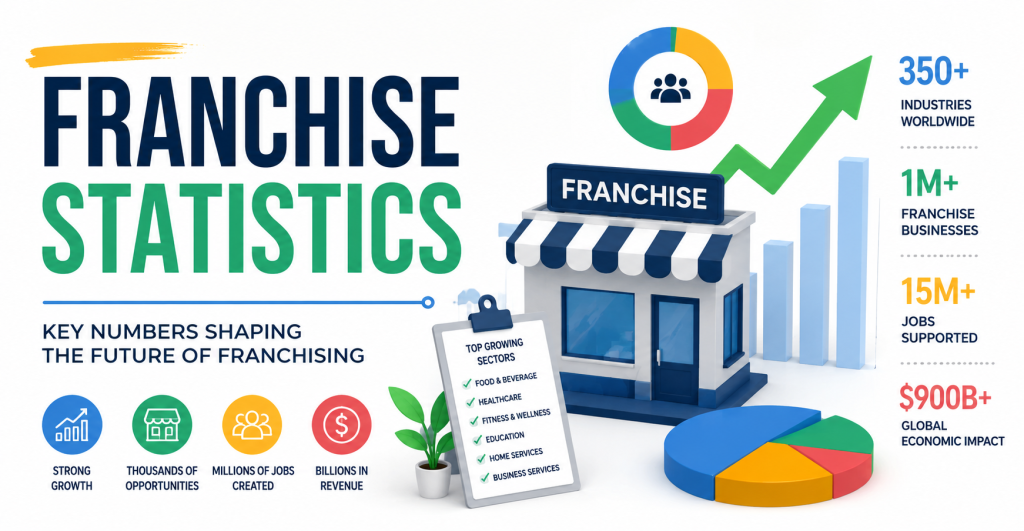

Starting a business from scratch can be exciting, but it also comes with uncertainty. From building a brand to attracting customers, entrepreneurs often spend years establishing a successful business. Franchising offers a different path. Instead of creating a business from the ground up, entrepreneurs can invest in an established brand with proven systems, operational support, and market recognition.
Over the past few decades, franchising has grown into one of the world’s most successful business models. From restaurants and coffee shops to fitness centers, healthcare services, retail stores, and education providers, franchise businesses now operate across almost every industry. As consumer demand continues to evolve, the franchise sector is expanding into new markets while creating opportunities for investors, business owners, and global brands.
Understanding franchise statistics helps entrepreneurs, investors, and industry professionals recognize where the market is headed and which sectors offer the strongest growth potential.
Franchise Statistics at a Glance
The franchise industry continues to demonstrate steady expansion as businesses look for scalable growth models and entrepreneurs seek lower-risk investment opportunities.
| Key Metric | Current Industry Trend |
|---|---|
| Global franchise market | Continues to expand across developed and emerging economies |
| Popular business sectors | Food & beverage, retail, healthcare, education, fitness, and business services |
| Primary growth driver | Brand recognition and proven business models |
| Fastest-growing franchise segment | Service-based and technology-enabled franchises |
| Business investment trend | Rising interest from first-time entrepreneurs and investors |
| Digital transformation | Increasing adoption of AI, online ordering, automation, and data analytics |
These trends highlight why franchising remains one of the most attractive business models for entrepreneurs seeking structured growth and long-term stability.
Why Franchising Continues to Grow
One of the biggest reasons behind the success of franchising is trust. Consumers are often more comfortable purchasing products or services from brands they already recognize. That familiarity gives franchise owners an advantage over completely new businesses that must build credibility from the beginning.
Franchise systems also provide operational guidance, marketing support, training programs, and standardized processes. These resources reduce many of the challenges new entrepreneurs typically face when launching independent businesses.
Digital transformation has further strengthened the franchise industry. Mobile ordering, loyalty programs, cloud-based management systems, AI-powered customer service, and digital marketing tools are helping franchise businesses improve customer experiences while increasing operational efficiency.
As technology continues evolving, franchising is becoming more scalable and accessible than ever before.
Industries Driving Franchise Growth
While restaurants remain one of the most recognizable franchise categories, today’s franchise market is far more diverse.
Healthcare franchises are expanding due to growing demand for home care, wellness services, and medical support. Fitness brands continue opening locations as consumers prioritize healthier lifestyles. Education franchises benefit from increasing interest in tutoring, language learning, and professional skill development.
Home improvement, cleaning services, logistics, pet care, childcare, and business consulting have also become popular franchise opportunities.
This diversification allows investors to choose franchise models that match changing consumer needs instead of relying solely on traditional retail businesses.
Franchise Growth by Industry
| Industry | Growth Outlook |
| Food & Beverage | Stable growth driven by convenience and delivery services |
| Healthcare | Strong demand supported by aging populations and wellness trends |
| Fitness & Wellness | Continued expansion through health-conscious consumers |
| Education & Training | Rising demand for tutoring, online learning, and professional development |
| Home Services | Increasing opportunities in maintenance, cleaning, and repair services |
| Business Services | Growing need for consulting, staffing, marketing, and technology support |
These sectors continue attracting entrepreneurs because they combine established demand with scalable franchise models.
Investment Trends in the Franchise Industry
Franchising continues to attract investors because it offers a balance between entrepreneurship and established business systems. While every investment carries some level of risk, many entrepreneurs view franchises as a more structured path to business ownership.
Instead of building a brand from scratch, franchise owners gain access to proven operating procedures, marketing strategies, supplier networks, and ongoing business support. This allows them to focus more on growing their local business rather than solving every operational challenge alone.
Another reason for the industry’s growth is changing consumer behavior. People increasingly value convenience, trusted brands, and consistent service. Whether ordering food through a mobile app, visiting a fitness center, or using home maintenance services, customers often choose businesses they already know and trust. This brand loyalty continues to drive franchise expansion across multiple sectors.
How Technology Is Reshaping Franchising
Technology is becoming one of the biggest growth drivers in the franchise industry.
Artificial intelligence is helping franchise owners understand customer preferences, forecast demand, automate marketing campaigns, and improve inventory management. Data analytics allows businesses to make better decisions by tracking sales performance, customer behavior, and operational efficiency.
Cloud-based management systems enable franchise owners to monitor multiple locations in real time, while mobile applications improve communication between franchisees, employees, and customers.
Digital payment solutions, online booking platforms, self-service kiosks, and loyalty programs have also become standard features in many franchise businesses. These innovations improve customer satisfaction while helping businesses operate more efficiently.
As technology continues advancing, franchises that embrace digital transformation are likely to remain more competitive in the years ahead.
Challenges Facing Franchise Businesses
Despite the industry’s strong growth, franchising is not without its challenges.
One of the biggest concerns for franchise owners is the initial investment. Depending on the brand and industry, startup costs can be substantial, including franchise fees, equipment, property, and operating expenses.
Competition is another challenge. Popular franchise sectors such as food service and retail often have many established players competing for the same customer base. Franchise owners must continue delivering excellent service while adapting to changing market trends.
Maintaining consistent quality across multiple locations can also be difficult. As franchise networks expand, ensuring that every location delivers the same customer experience becomes increasingly important.
Economic conditions, inflation, labor shortages, and supply chain disruptions may also affect franchise performance, making strong operational management essential.
The Future of the Franchise Industry
The future of franchising looks increasingly technology-driven and customer-focused.
Many franchise brands are investing in artificial intelligence, automation, and digital platforms to improve efficiency and enhance customer experiences. Sustainability is also becoming a key priority, with businesses adopting environmentally friendly practices, energy-efficient operations, and sustainable packaging.
Service-based franchises are expected to continue expanding as consumers seek convenient healthcare, education, home services, and wellness solutions. At the same time, hybrid business models that combine physical locations with digital services are becoming increasingly common.
International expansion also presents significant opportunities. As emerging markets continue developing, global franchise brands are entering new regions while local franchise concepts begin expanding internationally.
These trends suggest that franchising will remain an attractive business model for entrepreneurs and investors looking for long-term growth.
Key Takeaways
Franchise statistics highlight the continued strength of one of the world’s most successful business models. Brand recognition, proven operating systems, and ongoing support continue attracting entrepreneurs seeking structured business opportunities.
Technology is making franchise operations smarter through artificial intelligence, automation, cloud management, and digital customer engagement. At the same time, expanding industries such as healthcare, education, fitness, and home services are creating new opportunities beyond traditional food and retail franchises.
While challenges such as investment costs and market competition remain, the overall outlook for the franchise industry continues to be positive.
Final Thoughts
Franchising has evolved far beyond restaurants and retail stores. It has become a global business ecosystem that supports innovation, entrepreneurship, and economic growth across countless industries.
As consumer expectations continue changing, successful franchise businesses will be those that combine trusted brands with modern technology, excellent customer experiences, and adaptable business strategies.
For entrepreneurs, franchise statistics provide more than just numbers they reveal where markets are growing, which industries are expanding, and where future opportunities are emerging.
Whether you’re planning your first business investment, exploring new markets, or simply following industry trends, one thing is clear: franchising remains one of the most resilient and scalable business models in today’s economy.
With digital transformation, AI-powered operations, and growing demand for trusted brands, the franchise industry is well positioned for continued expansion in the years ahead.