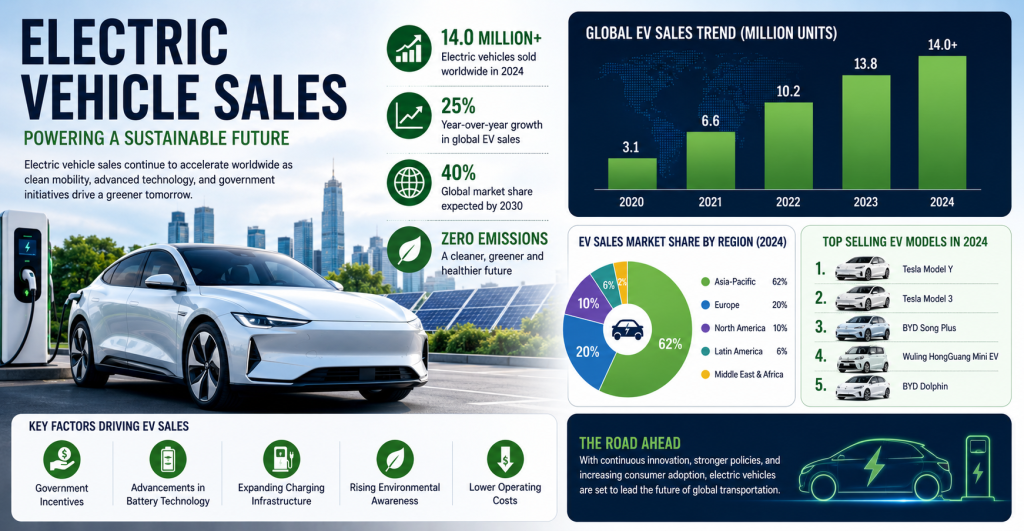

The global transition toward sustainable transportation is gaining remarkable momentum as electric vehicle (EV) sales continue to reach record-breaking levels. Rising consumer awareness, government incentives, expanding charging infrastructure, and continuous improvements in battery technology are driving widespread adoption of electric vehicles across passenger cars, commercial fleets, and public transportation.
Electric vehicles are no longer considered a niche alternative to conventional automobiles. Instead, they have become a central component of the global automotive industry, with manufacturers investing billions of dollars in new EV platforms, battery production facilities, and software-driven mobility solutions. As demand continues to increase, industry statistics reveal a significant transformation in how people purchase and use vehicles.
Global EV Sales Reach New Milestones
Electric vehicle sales have experienced exceptional growth over the past several years, fueled by favorable government policies, stricter emission regulations, and increasing availability of affordable electric models.
Countries across Asia, Europe, and North America continue expanding charging networks while encouraging consumers through purchase incentives, tax credits, and low-emission transportation initiatives.
Improved battery efficiency has also reduced one of the biggest concerns among consumers—driving range. Many modern electric vehicles now offer ranges exceeding 400–600 kilometers on a single charge, making them practical for both urban commuting and long-distance travel.
As battery manufacturing scales up, vehicle prices are gradually becoming more competitive with traditional gasoline-powered automobiles.
Key Electric Vehicle Sales Statistics
The electric mobility industry continues to demonstrate strong growth across global markets.
| EV Sales Metric | Latest Industry Insight |
|---|---|
| Global EV sales trend | Continued year-over-year growth |
| Fastest-growing vehicle segment | Battery Electric Vehicles (BEVs) |
| Major adoption regions | China, Europe, and North America |
| Charging infrastructure | Rapid expansion worldwide |
| Battery costs | Continuing long-term decline |
These trends indicate that electric vehicles are steadily becoming a mainstream transportation choice rather than an emerging technology.
Battery Innovation Drives Consumer Confidence
Advancements in battery technology remain one of the most important drivers behind rising electric vehicle sales.
Modern lithium-ion batteries deliver higher energy density, faster charging speeds, longer service life, and improved safety compared to previous generations.
Automakers are investing heavily in next-generation battery technologies, including solid-state batteries, lithium iron phosphate (LFP) chemistry, and advanced battery management systems that improve efficiency while reducing production costs.
Fast-charging capabilities continue to improve as well. Many new EV models can now recharge from 20% to 80% capacity in less than 30 minutes using high-speed charging stations.
These improvements significantly reduce charging anxiety while making electric vehicles more convenient for everyday use.
Expanding Charging Infrastructure Supports Adoption
The rapid growth of public and private charging infrastructure is playing a crucial role in accelerating EV adoption.
Governments and private companies are investing in:
- Ultra-fast highway charging stations
- Residential home charging solutions
- Workplace charging facilities
- Smart charging management systems
- Renewable energy-powered charging networks
The integration of charging infrastructure with solar and wind energy further strengthens the environmental benefits of electric transportation.
Smart charging technologies also help optimize electricity consumption by automatically scheduling vehicle charging during periods of lower grid demand.
Consumer Preferences Continue to Shift
Consumer attitudes toward electric mobility have evolved considerably in recent years.
Factors influencing purchasing decisions include:
- Lower operating costs
- Reduced fuel expenses
- Minimal maintenance requirements
- Environmental awareness
- Government incentives
- Improved vehicle performance
- Advanced digital features
Many electric vehicles now include intelligent driver assistance systems, over-the-air software updates, connected infotainment platforms, and AI-powered navigation systems that further enhance the ownership experience.
Automakers are also expanding their EV portfolios across multiple categories, including compact cars, luxury sedans, SUVs, pickup trucks, delivery vans, and commercial vehicles.
Regional Sales Performance
Different regions continue to drive global EV market expansion at varying speeds.
| Region | EV Growth Highlights |
|---|---|
| Asia-Pacific | Largest EV production and sales volumes |
| Europe | Strong government incentives and emissions policies |
| North America | Rapid expansion of charging infrastructure |
| India | Growing adoption supported by government initiatives |
| Latin America | Increasing investment in electric mobility |
Developing economies are beginning to accelerate EV adoption as charging networks improve and more affordable vehicle options become available.
Commercial Fleets Accelerate Electrification
Electric mobility is expanding beyond personal transportation.
Logistics companies, ride-sharing platforms, municipal transit agencies, and corporate fleet operators are increasingly replacing conventional vehicles with electric alternatives.
Commercial fleet electrification offers several benefits:
- Lower fuel costs
- Reduced maintenance expenses
- Improved operational efficiency
- Lower greenhouse gas emissions
- Compliance with sustainability goals
Electric buses and delivery vehicles are becoming increasingly common in urban environments where governments seek to reduce air pollution and noise levels.
Challenges Remain Despite Rapid Growth
Although electric vehicle adoption continues accelerating, several challenges remain.
Battery raw material availability, charging infrastructure expansion in rural regions, electricity grid modernization, and charging standard compatibility continue to require industry attention.
Manufacturers are also working to improve battery recycling systems that recover valuable materials such as lithium, nickel, and cobalt while supporting a circular economy.
Continued investment in renewable electricity generation will further strengthen the environmental benefits associated with electric transportation.
Future Technologies Will Shape the Next Generation
The future of electric mobility extends beyond battery-powered vehicles alone.
Emerging technologies expected to influence future EV sales include:
- Solid-state batteries
- Vehicle-to-grid (V2G) energy systems
- Autonomous driving technology
- AI-powered battery management
- Wireless charging systems
- Connected smart mobility platforms
These innovations are expected to improve vehicle efficiency, charging convenience, safety, and integration with intelligent transportation networks.
Automakers are increasingly positioning electric vehicles as software-defined platforms capable of receiving continuous performance improvements through over-the-air updates.
Looking Ahead
Electric vehicle sales continue to demonstrate the global automotive industry’s transformation toward cleaner, smarter, and more sustainable transportation. Improvements in battery technology, expanding charging infrastructure, supportive government policies, and growing consumer confidence are driving widespread adoption across developed and emerging markets alike.
As manufacturers introduce more affordable models and next-generation battery technologies mature, electric vehicles are expected to become increasingly accessible to consumers worldwide. Continued investments in charging networks, renewable energy integration, and battery recycling will further strengthen the long-term growth of electric mobility.
The rapid rise in electric vehicle sales reflects more than changing consumer preferences—it signals a fundamental shift toward a cleaner transportation future powered by innovation, sustainability, and digital technology.