
The global streaming industry has become one of the fastest-growing segments of the digital economy, fundamentally changing how people consume entertainment, music, sports, gaming, and live events. From subscription video-on-demand (SVOD) platforms to music streaming services and live streaming ecosystems, digital streaming has become an integral part of everyday life. The rapid expansion of high-speed internet, widespread smartphone adoption, smart TVs, cloud computing, and artificial intelligence has accelerated the industry’s growth across developed and emerging markets.
Today, consumers expect instant, personalized, and high-quality content across multiple devices. Streaming platforms are responding by investing billions of dollars in original programming, AI-powered recommendation engines, cloud infrastructure, and immersive viewing experiences. As competition intensifies among global streaming providers, businesses continue to innovate through interactive content, ad-supported subscription models, sports broadcasting rights, and localized programming.
Streaming Industry Overview
The streaming industry encompasses a wide range of digital services that deliver content over the internet instead of traditional cable or satellite networks. These services include video streaming, music streaming, cloud gaming, live streaming, podcasts, educational content, sports broadcasting, and enterprise video communication.
Consumers now access streaming services through smartphones, tablets, laptops, gaming consoles, connected TVs, and wearable devices. Advances in 5G connectivity and fiber broadband have significantly improved streaming quality while reducing buffering and latency.
Artificial intelligence has become a key competitive advantage by enabling platforms to personalize recommendations, optimize video quality, detect user preferences, and improve customer engagement.
Streaming Industry Statistics
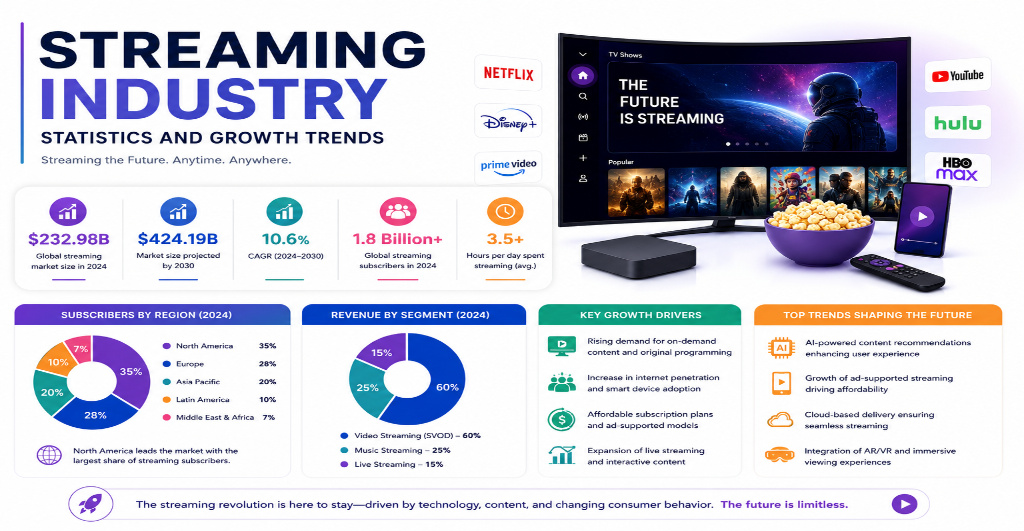
The streaming industry continues to experience remarkable expansion across every major digital content category.
- Millions of users worldwide now subscribe to one or more streaming services.
- Video streaming accounts for a significant share of global internet traffic.
- Smart TV adoption continues to drive longer streaming sessions and higher engagement.
- Mobile devices remain the fastest-growing platform for video consumption.
- Subscription-based streaming services generate billions of dollars in recurring annual revenue.
- Live streaming has become a major driver of gaming, sports, influencer marketing, and e-commerce engagement.
- AI-powered recommendation engines significantly increase viewer retention and watch time.
- Advertising-supported streaming platforms are attracting rapid user growth due to affordable pricing.
- Original content investments continue to reach record-breaking levels across major platforms.
- Emerging markets are becoming key growth engines as internet accessibility continues to improve.
Key Growth Trends Driving the Streaming Industry
One of the biggest trends shaping the streaming industry is the growing popularity of ad-supported subscription models. Many consumers are choosing lower-cost plans that include advertising, allowing streaming providers to diversify revenue streams while expanding their subscriber base.
Artificial intelligence is also transforming content discovery. Recommendation engines analyze viewing habits, search history, and user preferences to deliver personalized experiences that improve customer satisfaction and reduce subscriber churn.
Live sports streaming has become increasingly valuable as media companies compete for exclusive broadcasting rights. Major sporting events continue attracting millions of viewers, encouraging streaming platforms to invest heavily in premium sports content.
Cloud gaming is another rapidly growing segment, allowing users to stream high-quality games directly without expensive gaming hardware. Advances in cloud infrastructure and low-latency networking are making this technology increasingly accessible.
Localized content production is expanding worldwide as streaming companies invest in regional languages, cultures, and original programming to attract diverse audiences.
Emerging Technologies Transforming Streaming
Several technologies are redefining the future of streaming platforms.
Artificial intelligence improves recommendation systems, subtitle generation, automated content moderation, and video encoding efficiency.
Cloud computing enables scalable infrastructure capable of delivering millions of simultaneous streams while reducing operational costs.
5G technology supports ultra-high-definition streaming, real-time gaming, virtual events, and immersive interactive experiences with lower latency.
Edge computing enhances streaming performance by processing data closer to end users, minimizing buffering and improving video quality.
Virtual Reality (VR) and Augmented Reality (AR) are opening new opportunities for immersive entertainment, live concerts, virtual sports viewing, and interactive education.
Blockchain technology is gradually emerging for secure digital rights management, royalty distribution, and creator monetization.
Challenges Facing the Industry
Despite remarkable growth, streaming providers face several ongoing challenges.
Content production costs continue rising as platforms compete for exclusive programming and global audiences. Maintaining subscriber growth while controlling expenses has become increasingly important.
Market saturation in developed economies has intensified competition, leading companies to differentiate themselves through exclusive content, pricing strategies, and enhanced user experiences.
Cybersecurity threats, account sharing, digital piracy, and data privacy concerns require continuous investment in security infrastructure and content protection technologies.
Bandwidth limitations in developing regions can also affect streaming quality and user adoption.
Future Outlook
The future of the streaming industry remains exceptionally strong as digital transformation continues across entertainment, education, healthcare, enterprise communication, and gaming.
Artificial intelligence will become increasingly sophisticated, enabling hyper-personalized content recommendations, automated production workflows, multilingual localization, and predictive audience analytics.
Interactive entertainment, cloud gaming, live commerce, virtual events, and AI-generated content are expected to create entirely new revenue opportunities for streaming platforms.
As internet infrastructure expands globally and connected devices become more affordable, billions of additional consumers will gain access to streaming services over the coming decade.
Organizations that invest in innovative technologies, localized content strategies, and personalized customer experiences will be best positioned to lead the next phase of streaming industry growth.
Conclusion
The latest Streaming Industry Statistics and Growth Trends demonstrate how digital streaming has evolved into one of the world’s most dynamic technology sectors. Continuous innovation in artificial intelligence, cloud computing, 5G connectivity, immersive media, and personalized content delivery is reshaping how audiences consume entertainment and information.
As consumer preferences continue shifting toward on-demand digital experiences, the streaming industry is expected to remain a major driver of technological innovation, business growth, and global digital transformation for years to come.