
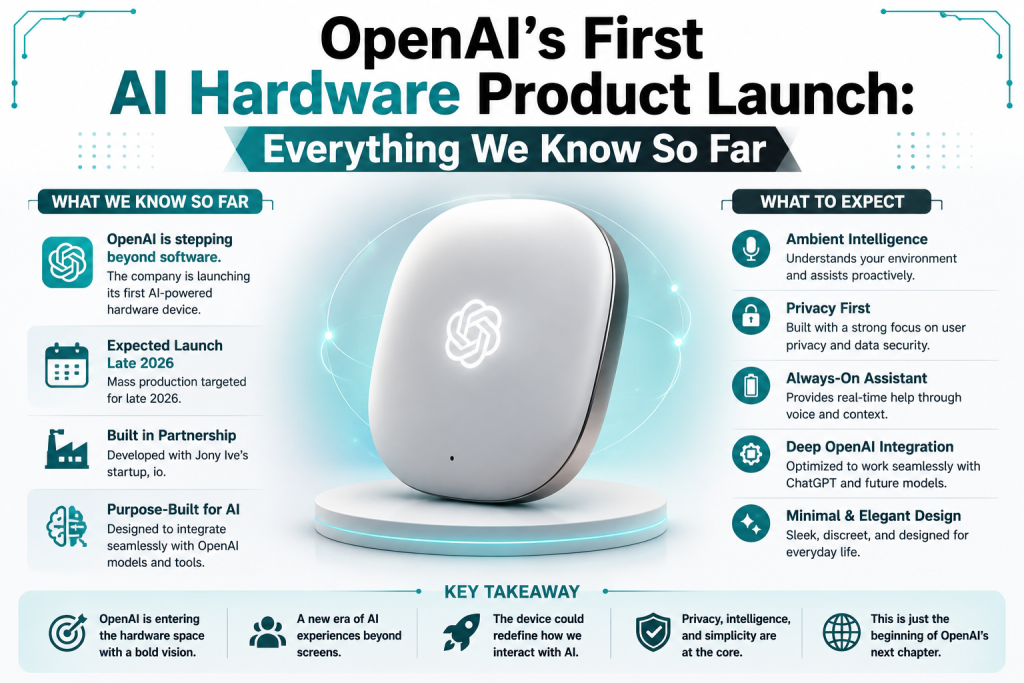

Artificial intelligence is no longer confined to software. After transforming the AI industry with ChatGPT, OpenAI is preparing to enter the hardware market with what could become one of the biggest technology launches of the decade. While the company has yet to officially unveil its first AI device, growing industry speculation and strategic announcements suggest that OpenAI is building a completely new way for people to interact with artificial intelligence.
Unlike traditional smartphones or laptops, OpenAI’s first hardware product is expected to be designed with AI at its core. The project has attracted worldwide attention following OpenAI’s collaboration with legendary Apple designer Jony Ive, whose iconic work includes the iPhone, iPad, MacBook, and Apple Watch. Together with OpenAI CEO Sam Altman, the team aims to create an AI-native device that feels as revolutionary as the smartphone did nearly twenty years ago.
Why Is OpenAI Building Hardware?
ChatGPT has become one of the fastest-growing AI applications in history, but OpenAI believes today’s devices were never designed for AI-first interactions.
Current computers and smartphones require users to switch between multiple apps, type commands, and manually search for information. OpenAI’s vision is different. The company wants AI to become a natural companion that understands context, responds instantly, and assists users throughout the day without requiring constant screen interaction.
This shift could fundamentally change how people work, communicate, and access information.
What Could the Device Look Like?
Although OpenAI has not officially revealed its product, technology analysts believe the company may introduce one of several possibilities.
Some experts expect a compact AI companion that users can carry everywhere. Others believe it could be a wearable device capable of providing real-time assistance through voice commands and contextual awareness. There is also speculation about a desktop AI assistant designed specifically for professional productivity.
Regardless of its final form, the product is expected to prioritize conversation over traditional app-based interfaces.
Features People Are Expecting
Several capabilities are widely anticipated based on OpenAI’s current technology roadmap.
Natural Voice Conversations
Instead of tapping screens and typing commands, users may simply speak naturally with the device.
Deep ChatGPT Integration
The hardware is expected to provide instant access to ChatGPT for writing, research, coding, translation, scheduling, brainstorming, and problem-solving.
Personalized AI Assistance
Future AI devices may remember user preferences, understand routines, and deliver more relevant responses over time.
Multimodal Intelligence
The product could combine voice, cameras, microphones, and sensors to better understand the user’s surroundings and respond intelligently.
Why Jony Ive’s Involvement Matters
The partnership with Jony Ive has significantly increased excitement surrounding the project.
Ive is widely recognized as one of the most influential product designers in modern technology. His philosophy emphasizes simplicity, elegance, and intuitive user experiences.
Many industry experts believe his collaboration with Sam Altman could lead to an entirely new category of consumer electronics centered around artificial intelligence rather than traditional computing.
Competition Is Heating Up
OpenAI is entering a rapidly evolving AI hardware market.
Major technology companies including Apple, Google, Meta, Microsoft, and Amazon are all investing heavily in AI-powered devices and intelligent assistants. However, OpenAI’s approach differs because the company is building hardware specifically around generative AI instead of adapting existing products.
This could provide OpenAI with a unique competitive advantage if the product successfully delivers a new user experience.
Challenges OpenAI Must Overcome
Launching an entirely new hardware category presents significant challenges.
Consumers must see clear value before adopting another personal device. Privacy and data security will remain major concerns for products that rely on continuous AI interaction. Battery efficiency, hardware performance, and affordability will also influence adoption.
OpenAI will need to balance innovation with practical everyday usability if it hopes to compete with established consumer electronics brands.
What This Means for the Future
OpenAI’s first hardware launch represents more than just another gadget—it could signal the beginning of AI-first computing.
If successful, future AI devices may reduce dependence on smartphones, simplify digital interactions, and create entirely new ways of communicating with technology. Businesses, developers, and consumers are closely watching the launch because it may influence the direction of artificial intelligence, consumer electronics, and digital productivity for years to come.
Final Thoughts
OpenAI has already changed how people use artificial intelligence through ChatGPT. Its upcoming hardware product has the potential to redefine how AI fits into everyday life. While many details remain confidential, the collaboration between Sam Altman and Jony Ive suggests that OpenAI is aiming for far more than another smart device.
Whether it becomes an AI companion, wearable assistant, or an entirely new product category, OpenAI’s first hardware launch is expected to be one of the most important technology events of the year and could shape the future of personal computing.