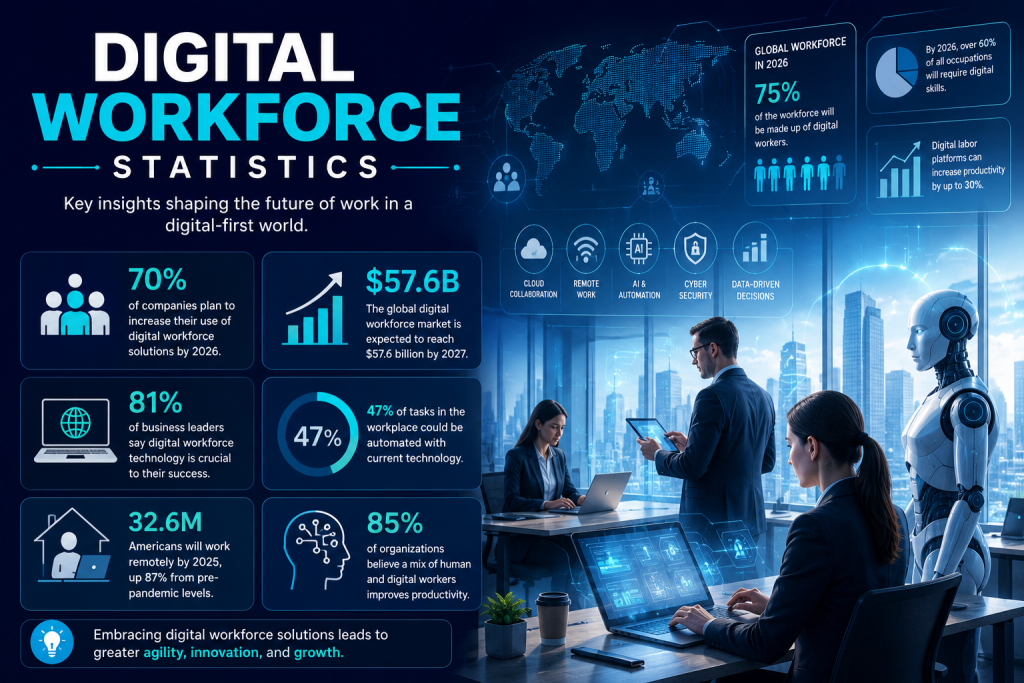

The digital workforce has become one of the most significant drivers of business transformation in recent years. Organizations across industries are adopting digital technologies, automation, artificial intelligence (AI), cloud computing, and remote collaboration tools to improve productivity and remain competitive. As businesses continue their digital transformation journeys, workforce structures are evolving rapidly, creating new opportunities and challenges for employers and employees alike.
Digital workforce statistics provide valuable insights into how technology is reshaping workplaces, employee productivity, hiring trends, and organizational efficiency. Understanding these trends helps businesses make informed decisions about talent acquisition, technology investments, and future workforce planning.
The Rise of the Digital Workforce
A digital workforce includes employees who use digital technologies to perform their daily responsibilities, as well as software bots and AI-powered systems that automate repetitive tasks. The widespread adoption of cloud platforms, collaboration software, and remote working solutions has accelerated this transformation.
Organizations increasingly rely on digital tools to manage communication, project collaboration, customer service, finance, marketing, and operations. As digital adoption grows, companies are investing more heavily in employee training to ensure workers possess the skills needed to succeed in technology-driven environments.
The shift toward hybrid and remote work has further strengthened the importance of digital workplaces, enabling businesses to recruit talent from across the globe.
Automation Is Enhancing Productivity
Automation continues to reshape business operations by reducing repetitive manual work and allowing employees to focus on higher-value activities. Robotic Process Automation (RPA), AI assistants, and workflow automation platforms help organizations improve efficiency while reducing operational costs.
Many businesses now automate tasks such as invoice processing, customer support responses, inventory updates, payroll management, and report generation. These technologies not only save time but also minimize human error and improve overall operational accuracy.
Rather than replacing workers entirely, automation increasingly supports employees by enhancing decision-making and streamlining daily workflows.
Artificial Intelligence Is Changing the Workplace
Artificial intelligence has become an essential component of the digital workforce. AI-powered tools assist employees by analyzing large volumes of data, generating reports, forecasting trends, and providing intelligent recommendations.
Customer service departments increasingly use AI chatbots to answer routine inquiries, allowing human representatives to handle more complex issues. Marketing teams use AI for personalized campaigns, while finance departments leverage predictive analytics to improve financial planning.
Generative AI is also transforming content creation, software development, research, and knowledge management, enabling professionals to complete tasks more efficiently than ever before.
Remote and Hybrid Work Continue to Grow
One of the most important workforce trends is the continued growth of remote and hybrid work models. Businesses have recognized that flexible working arrangements can improve employee satisfaction while reducing office operating expenses.
Cloud computing, video conferencing platforms, project management software, and digital collaboration tools have made remote work practical for millions of professionals worldwide.
Many organizations now offer hybrid work environments that combine in-office collaboration with remote flexibility, allowing employees to achieve a better work-life balance while maintaining productivity.
Digital Skills Are Becoming Essential
As technology adoption accelerates, employers increasingly prioritize digital skills during recruitment. Technical expertise in cloud computing, cybersecurity, artificial intelligence, data analytics, software development, and digital marketing remains highly valuable across industries.
However, digital transformation also increases demand for soft skills such as adaptability, communication, problem-solving, creativity, and continuous learning.
Companies are investing in employee upskilling and reskilling programs to prepare their workforce for rapidly changing technological environments. Online learning platforms and professional certifications make it easier for employees to acquire new competencies throughout their careers.
Cybersecurity and Data Protection
A growing digital workforce also increases cybersecurity responsibilities. Remote work environments require organizations to secure sensitive business information across multiple devices and locations.
Businesses continue investing in multi-factor authentication, cloud security, endpoint protection, employee cybersecurity training, and data encryption technologies.
Creating a strong cybersecurity culture helps organizations reduce risks associated with phishing attacks, ransomware, and data breaches while maintaining customer trust.
Future Workforce Trends
Several emerging technologies are expected to shape the next generation of digital workplaces. Artificial intelligence will become increasingly integrated into everyday business applications, while advanced analytics will provide deeper operational insights.
Virtual reality and augmented reality may enhance employee training, remote collaboration, and technical support. Blockchain technology could improve identity verification, contract management, and secure record keeping.
Organizations will continue prioritizing employee experience through intelligent workplace technologies that improve collaboration, flexibility, and overall productivity.
Conclusion
Digital workforce statistics highlight the growing influence of technology on modern business operations. Automation, artificial intelligence, cloud computing, and remote collaboration are transforming how organizations operate and how employees perform their daily responsibilities.
Businesses that invest in digital technologies, workforce training, cybersecurity, and innovation will be better positioned for long-term success. At the same time, employees who continuously develop digital skills and embrace lifelong learning will remain competitive in an increasingly technology-driven job market.
As digital transformation continues across industries, the digital workforce will remain central to economic growth, organizational resilience, and the future of work.