
Climate change has become one of the most significant global challenges of the 21st century. Rising greenhouse gas emissions, increasing global temperatures, melting glaciers, and more frequent extreme weather events are affecting ecosystems, economies, and communities worldwide. According to leading scientific organizations, human activities—primarily the burning of fossil fuels such as coal, oil, and natural gas—are the primary drivers of modern climate change. As countries work toward reducing carbon emissions and achieving net-zero targets, renewable energy has emerged as one of the most effective solutions for limiting future warming and building a more sustainable energy system.
Global Temperature Rise
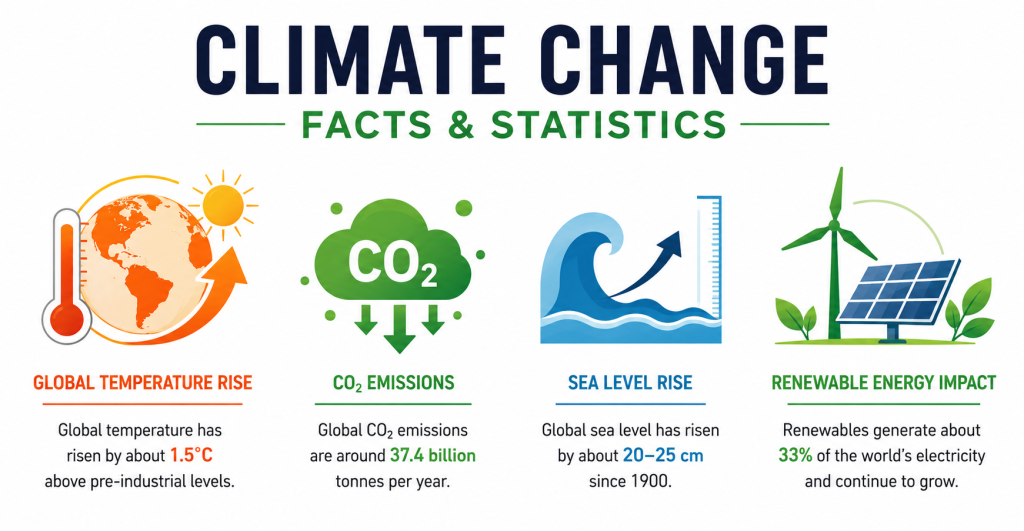
The Earth’s average surface temperature has increased significantly since the late 19th century due to the accumulation of greenhouse gases in the atmosphere. Scientists report that recent years have been among the warmest ever recorded, with global temperatures now approximately 1.5°C above the pre-industrial average. Rising temperatures contribute to more frequent heatwaves, droughts, wildfires, changing rainfall patterns, and stronger storms. These climate-related changes affect agriculture, biodiversity, water resources, and public health across every continent.
Global Temperature Statistics
| Indicator | Latest Value |
|---|---|
| Global temperature increase since 1850–1900 | ~1.5°C |
| Warmest year on record | 2024 |
| Average warming per decade (since 1980) | ~0.20°C |
| Major cause | Greenhouse gas emissions |
Global CO₂ Emissions
Carbon dioxide (CO₂) is the largest contributor to human-caused climate change. The majority of global CO₂ emissions come from electricity generation, transportation, manufacturing, construction, and industrial activities powered by fossil fuels. Although renewable energy adoption continues to grow, global energy demand has also increased, making emissions reductions a major challenge. Many countries have pledged to achieve net-zero emissions by 2050 or later through cleaner technologies, energy efficiency, and low-carbon infrastructure.
Global CO₂ Emissions Statistics
| Indicator | Latest Value |
|---|---|
| Global energy-related CO₂ emissions | ~37.4 billion tonnes/year |
| Largest emission source | Energy sector |
| Major fossil fuel contributors | Coal, Oil, Natural Gas |
| Countries with net-zero targets | 140+ |
Global Sea Level Rise
Global sea levels are rising because of melting glaciers, shrinking polar ice sheets, and the thermal expansion of seawater as oceans warm. Even gradual increases in sea level can lead to more frequent coastal flooding, erosion, saltwater intrusion into freshwater supplies, and greater risks during tropical storms. Coastal cities and island nations are particularly vulnerable to these long-term impacts.
Sea Level Statistics
| Indicator | Latest Value |
|---|---|
| Average global sea level rise since 1900 | ~20–25 cm |
| Current annual rise | ~4–5 mm/year |
| Primary causes | Ice sheet melting & ocean warming |
| Most vulnerable regions | Coastal cities & Small Island States |
Renewable Energy’s Impact on Climate Change
Renewable energy plays a critical role in reducing greenhouse gas emissions and limiting global warming. Unlike coal, oil, and natural gas, renewable sources such as solar, wind, hydropower, geothermal, and biomass generate electricity with little or no direct carbon emissions. Rapid growth in renewable energy capacity has already helped reduce dependence on fossil fuels in many countries. Continued investment in clean energy, battery storage, smart grids, and electric transportation is expected to further decrease global emissions while improving energy security and supporting sustainable economic development.
Renewable Energy Impact Statistics
| Indicator | Value |
|---|---|
| Share of global electricity from renewables | ~33% |
| Fastest-growing renewable source | Solar Power |
| Largest renewable electricity source | Hydropower |
| Expected renewable share by 2030 | ~46% |
| Clean energy investment trend | Record-high globally |
Key Climate Change Facts
- Global temperatures are approximately 1.5°C higher than pre-industrial levels.
- Energy-related CO₂ emissions remain above 37 billion tonnes annually.
- Global sea levels have risen by around 20–25 centimeters since 1900.
- Renewable energy now generates about one-third of the world’s electricity.
- Solar and wind power continue to be the fastest-growing sources of new electricity generation.
- Governments and businesses worldwide are investing heavily in clean energy to achieve long-term climate and sustainability goals.
Conclusion
Climate change continues to reshape the global environment, economy, and energy landscape. Rising temperatures, increasing carbon emissions, and accelerating sea level rise highlight the urgent need for climate action. Expanding renewable energy, improving energy efficiency, and reducing dependence on fossil fuels are among the most effective strategies for limiting future warming and supporting sustainable development. As technological innovation and international cooperation continue to advance, the transition to a low-carbon economy will play a crucial role in protecting the planet for future generations.
SEO Keywords: Climate Change Statistics 2026, Global Warming Facts, CO₂ Emissions Statistics, Sea Level Rise Data, Renewable Energy Statistics, Climate Change Facts, Global Temperature Rise, Clean Energy Trends, Net Zero Emissions, Environmental Statistics.