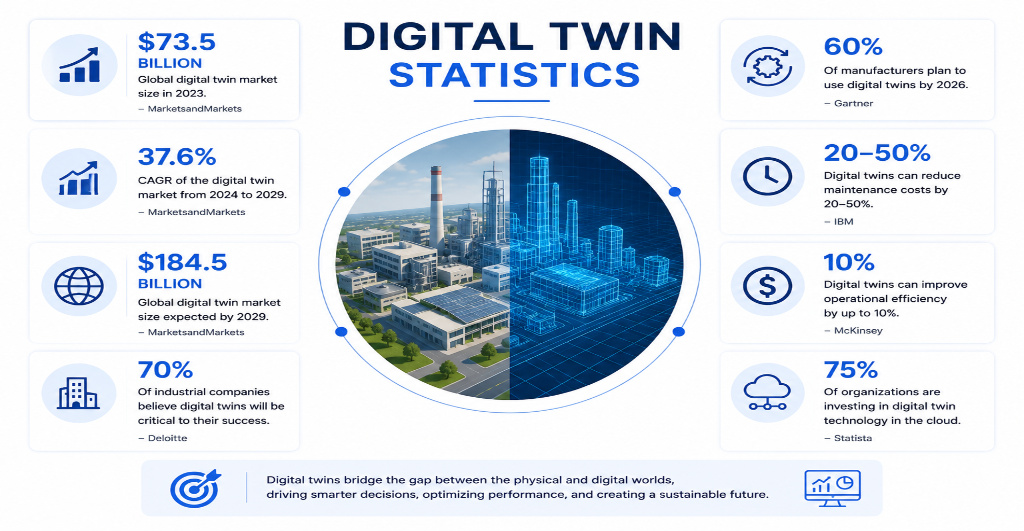

Digital twin technology is rapidly transforming industries by creating virtual replicas of physical assets, systems, and processes. These digital models enable organizations to monitor operations in real time, predict equipment failures, optimize performance, and reduce operational costs. As businesses accelerate digital transformation initiatives, Digital Twin Statistics highlight the growing adoption of this technology across manufacturing, healthcare, smart cities, automotive, aerospace, and energy sectors.
Powered by artificial intelligence (AI), the Internet of Things (IoT), cloud computing, and advanced analytics, digital twins are becoming an essential tool for improving productivity and decision-making. In this article, we explore the latest digital twin statistics, market trends, adoption rates, industry applications, and future outlook.
Digital Twin Statistics (2026)
Here are some of the most important statistics demonstrating the rapid growth of digital twin technology:
- The global digital twin market is projected to grow at a double-digit CAGR throughout the decade.
- Manufacturing remains the largest adopter of digital twin technology worldwide.
- More than 70% of industrial organizations are expected to implement digital twin solutions as part of their Industry 4.0 initiatives by the end of the decade.
- AI-powered digital twins are becoming increasingly common for predictive maintenance and operational optimization.
- Smart factories using digital twins can significantly reduce equipment downtime through real-time monitoring.
- The automotive industry continues to invest heavily in digital twins for vehicle design, simulation, and autonomous driving development.
- Digital twins are helping healthcare providers improve patient care through personalized treatment simulations and hospital asset management.
- Smart city projects increasingly rely on digital twins to optimize transportation, utilities, and urban planning.
- Cloud-based digital twin platforms are experiencing faster adoption than traditional on-premise solutions.
- IoT device expansion continues to accelerate digital twin deployment across industrial sectors.
Why Digital Twin Technology Is Growing So Quickly
Several factors are driving the rapid expansion of digital twin adoption worldwide.
Industry 4.0 Transformation
Manufacturers are embracing Industry 4.0 technologies to improve production efficiency, automate operations, and reduce maintenance costs. Digital twins play a central role by providing real-time visibility into factory operations.
Growth of IoT Devices
Billions of connected sensors continuously collect operational data from machines, buildings, and infrastructure. Digital twins use this data to create accurate virtual representations that support predictive analytics.
Artificial Intelligence Integration
AI enables digital twins to move beyond visualization by providing intelligent recommendations, forecasting failures, and optimizing business operations automatically.
Cloud Computing
Cloud infrastructure allows organizations to manage digital twin models securely while supporting large-scale simulations without expensive local hardware.
Industry-Wise Digital Twin Statistics
Manufacturing
Manufacturing accounts for the largest share of digital twin deployments.
Key applications include:
- Predictive maintenance
- Production optimization
- Quality control
- Supply chain monitoring
- Factory automation
Manufacturers using digital twins can improve equipment reliability while reducing maintenance costs and unplanned downtime.
Automotive
Automotive companies use digital twins throughout the product lifecycle.
Popular applications include:
- Vehicle simulation
- Autonomous driving development
- Battery performance monitoring
- Smart manufacturing
- Connected vehicle diagnostics
Digital twins significantly reduce prototype costs while accelerating product development.
Healthcare
Healthcare organizations are increasingly adopting digital twins for:
- Personalized medicine
- Hospital equipment monitoring
- Surgical planning
- Medical device optimization
- Patient health simulation
The integration of AI is making digital healthcare models more accurate than ever before.
Energy and Utilities
Energy providers use digital twins to monitor:
- Power plants
- Wind farms
- Solar installations
- Electrical grids
- Oil and gas infrastructure
Real-time analytics improve operational efficiency while reducing maintenance expenses.
Smart Cities
Governments are using digital twins to improve:
- Traffic management
- Public transportation
- Water systems
- Energy distribution
- Urban planning
- Disaster response
Digital twins enable city planners to simulate infrastructure changes before implementation.
Technologies Powering Digital Twins
Several emerging technologies are accelerating digital twin innovation.
These include:
- Artificial Intelligence (AI)
- Machine Learning
- Internet of Things (IoT)
- Cloud Computing
- Edge Computing
- 5G Connectivity
- Big Data Analytics
- Augmented Reality (AR)
- Virtual Reality (VR)
Together, these technologies provide accurate real-time data and predictive insights.
Business Benefits of Digital Twins
Organizations investing in digital twin technology report numerous advantages.
Improved Predictive Maintenance
Digital twins identify equipment issues before failures occur, reducing costly downtime.
Lower Operational Costs
Real-time optimization helps reduce waste, improve energy efficiency, and streamline maintenance activities.
Faster Product Development
Virtual simulations allow engineers to test products digitally before physical production begins.
Better Decision-Making
Executives gain access to real-time operational intelligence that supports strategic planning.
Sustainability Improvements
Digital twins help organizations optimize resource consumption, reduce emissions, and improve environmental performance.
Challenges Facing Digital Twin Adoption
Despite rapid growth, organizations continue to face several implementation challenges.
These include:
- High implementation costs
- Data integration complexity
- Cybersecurity risks
- Skilled workforce shortages
- Legacy infrastructure compatibility
- Large-scale data management
Overcoming these barriers will be critical for wider adoption.
Future Outlook
The future of digital twins looks exceptionally promising. As AI becomes more advanced and IoT networks continue expanding, digital twins will evolve into intelligent systems capable of autonomous decision-making and real-time optimization.
Emerging technologies such as generative AI, edge computing, quantum computing, and 6G connectivity are expected to further enhance digital twin capabilities across industries.
Organizations investing in digital twins today will likely gain significant competitive advantages through increased operational efficiency, lower costs, improved sustainability, and better customer experiences.
Conclusion
The latest Digital Twin Statistics demonstrate how this technology is reshaping industries worldwide. From manufacturing and healthcare to automotive, energy, and smart cities, digital twins are becoming a cornerstone of digital transformation. Supported by AI, IoT, cloud computing, and advanced analytics, these virtual models enable organizations to optimize operations, improve decision-making, and accelerate innovation. As adoption continues to grow, digital twins will play an increasingly important role in building smarter, more efficient, and sustainable industries.