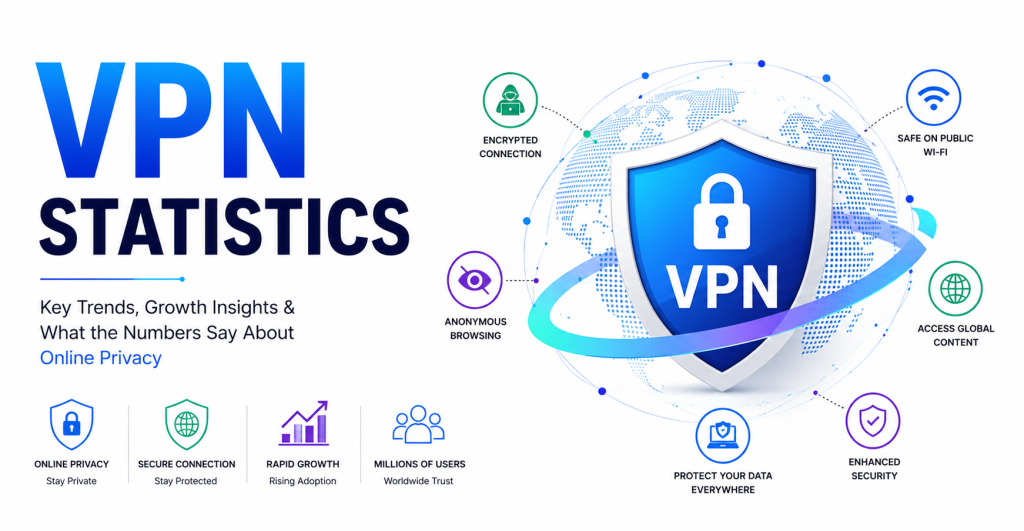

The internet has become an essential part of everyday life. From online banking and remote work to shopping, streaming, and social media, people now spend several hours a day connected to the digital world. While this convenience has transformed how we live and work, it has also increased concerns about online privacy, cybersecurity, and data protection.
As cyber threats continue to evolve, more individuals and businesses are turning to Virtual Private Networks (VPNs) to protect their online activities. Once considered a tool mainly for IT professionals, VPNs have become mainstream solutions for remote workers, travelers, students, businesses, and privacy-conscious internet users.
The growing demand for secure internet access has led to rapid expansion in the VPN industry. Understanding VPN statistics provides valuable insight into changing digital habits, cybersecurity awareness, and the future of online privacy.
VPN Statistics at a Glance
The VPN market continues to expand as internet users become more aware of digital security and data privacy.
| Key Metric | Current Trend |
|---|---|
| Global VPN adoption | Continues to grow across personal and business users |
| Primary reason for VPN usage | Privacy and online security |
| Fastest-growing user segment | Remote workers and mobile users |
| Most popular devices | Smartphones and laptops |
| Business adoption | Increasing among organizations with hybrid workforces |
| Major market driver | Rising cybersecurity threats and privacy concerns |
These trends highlight one clear reality: VPNs are no longer optional tools for technology experts—they have become an essential part of modern internet usage.
Why VPN Usage Is Rising Worldwide
A decade ago, many people had never heard of a VPN. Today, millions rely on one every day.
One of the biggest reasons is the growing concern over personal data. Every website visited, online purchase made, or public Wi-Fi connection used creates opportunities for sensitive information to be exposed. High-profile cyberattacks and data breaches have made internet users more cautious about how their information is collected and stored.
Remote work has also accelerated VPN adoption. Employees regularly access company systems from home, airports, cafés, and coworking spaces. VPNs create encrypted connections that help businesses protect confidential information while allowing employees to work securely from almost anywhere.
Streaming services have also contributed to growing VPN usage. Many users rely on VPNs to access region-specific content while traveling, adding another reason for widespread adoption.
Who Uses VPNs?
VPN users are no longer limited to cybersecurity professionals.
Working professionals use VPNs to securely connect to corporate networks and protect confidential business data. Students use them to access educational resources and maintain privacy while studying online. Travelers rely on VPNs when connecting to public Wi-Fi networks in hotels, airports, and cafés.
Businesses of all sizes are increasingly adopting VPN technology as hybrid and remote work become permanent parts of their operations. Startups, multinational companies, government organizations, and educational institutions all recognize the importance of secure digital communication.
Even everyday internet users now install VPN applications simply to browse the web more privately and reduce online tracking.
The Business Impact of VPN Growth
The increasing demand for VPN services has created opportunities far beyond software providers.
Cloud computing companies are integrating VPN capabilities into enterprise security platforms. Cybersecurity firms continue expanding managed security services. Internet infrastructure providers are investing in encrypted networking technologies, while software developers build privacy-focused applications for both businesses and consumers.
The growing VPN ecosystem has also created opportunities for cybersecurity consultants, IT service providers, managed security companies, and digital privacy startups.
As organizations invest more heavily in protecting digital assets, demand for secure networking solutions is expected to remain strong.
VPN Usage Across Different Industries
Although VPNs are widely used by individuals, several industries have become particularly dependent on secure remote connectivity.
Healthcare organizations use VPNs to protect patient records and comply with privacy regulations. Financial institutions rely on encrypted networks to safeguard sensitive transactions. Educational institutions support online learning through secure remote access, while technology companies depend on VPNs to protect software development environments and internal communications.
Government agencies, law firms, manufacturing companies, and media organizations also use VPNs to reduce cybersecurity risks and enable secure collaboration across distributed teams.
Digital security has become a business necessity rather than simply an IT responsibility.
VPN Adoption by User Type
VPN usage has expanded across multiple user groups as internet privacy becomes a greater concern. While businesses remain major users of VPN technology, individuals are also embracing secure browsing for work, education, entertainment, and personal safety.
| User Group | Primary Reason for Using a VPN |
|---|---|
| Remote Employees | Secure access to company networks |
| Businesses | Protect sensitive corporate data |
| Students | Access online learning resources securely |
| Travelers | Safe browsing on public Wi-Fi |
| Gamers | Improve privacy and reduce network restrictions |
| Everyday Internet Users | Protect personal information and online privacy |
These trends show that VPN technology is no longer limited to corporate environments. It has become a practical tool for millions of internet users worldwide.
The Role of Artificial Intelligence in VPN Technology
Artificial intelligence is beginning to reshape the VPN industry in several ways.
Modern VPN providers are using AI to detect unusual network activity, identify suspicious login attempts, and respond to potential cyber threats in real time. Instead of relying solely on manual monitoring, intelligent systems can analyze enormous amounts of network data and react much faster than traditional security tools.
Machine learning is also helping optimize server performance by automatically selecting the fastest and most secure connection for users. This improves browsing speed while maintaining strong encryption.
As cyberattacks become more sophisticated, AI-powered VPN solutions are expected to become an increasingly important part of modern cybersecurity strategies.
Challenges Facing the VPN Industry
Despite their growing popularity, VPN services still face several challenges.
One of the biggest issues is user awareness. Many people still misunderstand what a VPN can and cannot do. While a VPN encrypts internet traffic and improves privacy, it does not provide complete protection against phishing attacks, malware, or unsafe online behavior.
Connection speed can also vary depending on server location and encryption levels. Some users experience slower internet performance when connected to distant servers.
Another challenge is trust. Since VPN providers manage encrypted internet traffic, users need confidence that their chosen service follows transparent privacy practices and does not collect unnecessary personal data.
Regulatory differences between countries also influence VPN usage. Some regions encourage encrypted communication, while others impose restrictions on VPN services.
Why Businesses Continue Investing in VPN Solutions
For businesses, cybersecurity has become one of the most important operational priorities.
Remote and hybrid work environments require employees to access company systems from multiple locations and devices. VPNs provide encrypted connections that reduce the risk of unauthorized access while allowing teams to collaborate securely.
Organizations also recognize the financial impact of cyberattacks. Data breaches can result in operational disruption, financial losses, regulatory penalties, and reputational damage. Investing in secure networking infrastructure often costs far less than recovering from a major security incident.
Beyond security, VPNs help organizations maintain business continuity by enabling employees to work safely from almost anywhere in the world.
The Future of VPN Technology
The future of VPN technology will extend beyond simple encrypted browsing.
As cloud computing, artificial intelligence, and zero-trust security models continue to evolve, VPN services are expected to become more intelligent, automated, and integrated with broader cybersecurity platforms.
Businesses will increasingly combine VPN technology with multi-factor authentication, identity management, endpoint protection, and AI-powered threat detection to create stronger security ecosystems.
Consumer VPN services are also expected to become faster, easier to use, and more accessible through mobile-first applications and smarter network optimization.
Growing awareness of digital privacy, increasing cyber threats, and expanding remote work are likely to keep global demand for VPN services strong throughout the coming years.
Key Takeaways
VPN statistics clearly demonstrate that online privacy has become a global priority.
Individuals are using VPNs to browse more securely, protect personal information, and access the internet with greater confidence. Businesses continue investing in encrypted communication to support remote work and strengthen cybersecurity.
Artificial intelligence, cloud computing, and digital transformation are further accelerating the evolution of VPN technology, making secure internet access more efficient and widely available.
As cyber risks continue to grow, VPNs are becoming an essential part of everyday digital life rather than a specialized technology for IT professionals.
Final Thoughts
The internet has opened countless opportunities for communication, education, business, and innovation, but it has also introduced new security challenges that cannot be ignored.
VPN technology has emerged as one of the most effective tools for protecting online privacy, securing business communications, and reducing cyber risks. Its growing adoption reflects a broader shift toward safer and more responsible internet usage.
While VPNs are not a complete cybersecurity solution, they remain an important first line of defense in an increasingly connected world.
For businesses, VPN statistics reveal a growing investment in digital security. For individuals, they highlight the importance of protecting personal information in an era where privacy has become more valuable than ever.
As technology continues to evolve, VPNs will play an even greater role in helping people and organizations navigate the digital world with confidence, security, and peace of mind.