
Big data has become one of the most valuable assets for businesses in the digital age. Every second, billions of data points are generated from smartphones, social media, IoT devices, cloud applications, online transactions, and connected machines. Organizations are increasingly leveraging this data to improve customer experiences, optimize operations, predict market trends, and gain a competitive advantage.
In 2026, the adoption of big data technologies continues to accelerate as enterprises invest in artificial intelligence (AI), machine learning (ML), cloud computing, and advanced analytics. Businesses across healthcare, banking, retail, manufacturing, telecommunications, and government sectors are using big data to make faster and smarter decisions.
The growing demand for real-time insights, predictive analytics, and personalized services is fueling investments in modern data platforms capable of processing structured and unstructured information at massive scale.
Key Highlights
- Organizations continue to generate record-breaking volumes of digital data.
- AI and machine learning are driving greater demand for big data analytics.
- Cloud-based data platforms are replacing traditional on-premise infrastructure.
- Real-time analytics is becoming essential for business decision-making.
- Predictive analytics is improving operational efficiency across industries.
- Data privacy and cybersecurity remain major enterprise priorities.
- IoT devices continue to expand global data generation.
- Data governance is becoming increasingly important for regulatory compliance.
What Is Big Data?
Big data refers to extremely large and complex datasets that cannot be efficiently processed using traditional data management tools. These datasets are characterized by their volume, velocity, variety, veracity, and value—commonly known as the 5 Vs of Big Data.
Organizations use big data technologies to collect, store, analyze, and visualize information from multiple sources, enabling informed decision-making and business innovation.
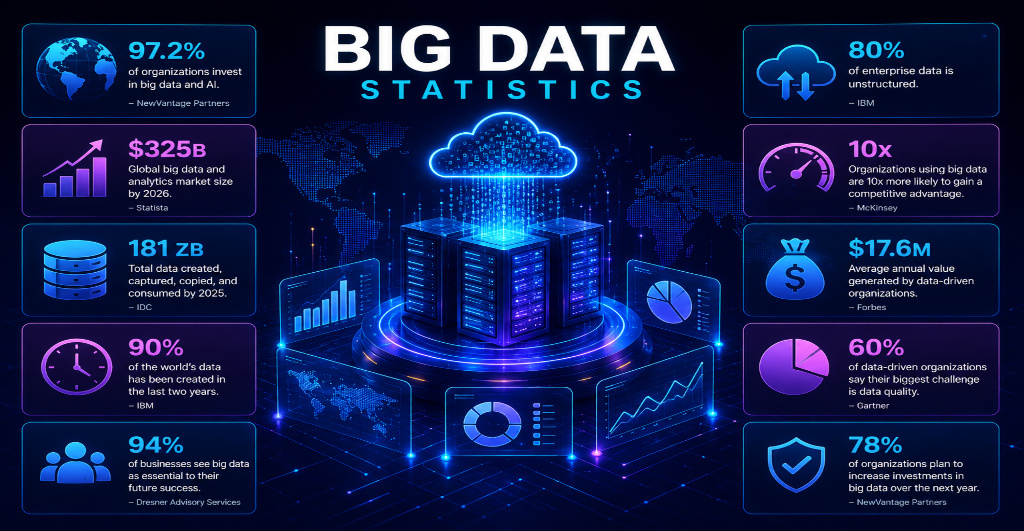
10 Big Data Statistics You Should Know in 2026
1. Global data creation continues to grow rapidly.
Every day, businesses and consumers generate massive amounts of digital information through online activities, connected devices, and enterprise applications.
2. Cloud computing dominates big data infrastructure.
Most new big data projects are deployed on cloud platforms due to their scalability, flexibility, and lower operational costs.
3. AI adoption is increasing demand for high-quality data.
Artificial intelligence models rely heavily on accurate and diverse datasets to deliver reliable predictions and automation.
4. Retail companies use big data for personalization.
Retailers analyze customer behavior, purchasing history, and browsing patterns to deliver targeted recommendations and improve customer engagement.
5. Healthcare organizations leverage predictive analytics.
Hospitals use big data to improve diagnostics, optimize treatment plans, monitor patients remotely, and enhance operational efficiency.
6. Financial institutions rely on data analytics for fraud detection.
Banks analyze millions of transactions in real time to identify suspicious activities and strengthen security.
7. Manufacturing companies optimize production using IoT data.
Smart factories collect sensor data to monitor equipment performance, reduce downtime, and improve product quality.
8. Data governance is becoming a strategic priority.
Organizations are investing in data quality, compliance, privacy, and governance frameworks to meet evolving regulatory requirements.
9. Cybersecurity analytics continues to expand.
Security teams analyze vast amounts of network and user activity to detect threats before they become major incidents.
10. Data-driven decision-making is now a competitive advantage.
Companies using advanced analytics consistently make faster, more informed business decisions than organizations relying on traditional reporting methods.
Why Big Data Matters
Data is no longer simply stored—it is analyzed to generate actionable insights.
Big data enables organizations to:
- Improve customer experiences
- Optimize supply chains
- Detect fraud faster
- Predict market demand
- Personalize marketing campaigns
- Enhance operational efficiency
- Support strategic decision-making
- Drive product innovation
Organizations that effectively utilize data often gain a significant competitive advantage in their respective industries.
Industries Leading Big Data Adoption
Healthcare
Healthcare providers use big data for patient monitoring, disease prediction, medical research, precision medicine, and hospital management.
Banking and Finance
Financial institutions rely on analytics for fraud prevention, credit scoring, risk management, regulatory compliance, and investment strategies.
Retail and E-commerce
Retail businesses analyze customer preferences, inventory trends, and purchasing behavior to improve sales and customer satisfaction.
Manufacturing
Manufacturers leverage predictive maintenance, quality control, demand forecasting, and production optimization using real-time data.
Telecommunications
Telecom companies analyze network performance, customer behavior, and service quality to improve connectivity and reduce churn.
Government
Public agencies use big data for smart city initiatives, transportation planning, emergency response, public safety, and digital governance.
Emerging Big Data Trends
Several technologies are shaping the future of big data.
Artificial Intelligence Integration
AI-powered analytics platforms automatically identify patterns, anomalies, and business opportunities hidden within massive datasets.
Edge Computing
Processing data closer to its source reduces latency and supports real-time applications such as autonomous vehicles and industrial automation.
Data Fabric Architecture
Modern enterprises are adopting unified data management platforms that integrate information across multiple cloud and on-premise environments.
Data Privacy Technologies
Privacy-enhancing technologies help organizations protect sensitive information while complying with increasingly strict regulations.
Real-Time Analytics
Businesses increasingly require immediate insights instead of waiting for scheduled reports, enabling faster responses to market changes.
Challenges Facing Big Data
Despite its advantages, organizations continue to face several obstacles:
- Managing rapidly growing data volumes
- Ensuring data quality and accuracy
- Protecting sensitive customer information
- Addressing cybersecurity threats
- Integrating data across multiple systems
- Hiring skilled data professionals
- Meeting global compliance requirements
Overcoming these challenges requires modern infrastructure, strong governance, and ongoing investment in analytics capabilities.
Future Outlook
The future of big data will be driven by AI, cloud computing, automation, and connected devices. As businesses generate increasingly complex datasets, advanced analytics platforms will become essential for transforming raw information into strategic insights.
Emerging technologies such as quantum computing, autonomous AI agents, digital twins, and intelligent data management systems will further enhance the ability of organizations to analyze and utilize data at unprecedented speed and scale.
Businesses that prioritize data quality, governance, and AI-powered analytics will be better positioned to innovate, improve operational efficiency, and respond quickly to changing market conditions.
Conclusion
Big data continues to redefine how organizations operate in 2026. From improving customer experiences and strengthening cybersecurity to enabling predictive analytics and AI-driven decision-making, data has become a critical business asset.
As digital transformation accelerates across industries, organizations that invest in modern big data technologies, robust governance frameworks, and skilled data professionals will gain lasting competitive advantages. The future belongs to businesses that can transform vast amounts of information into meaningful insights and actionable strategies.