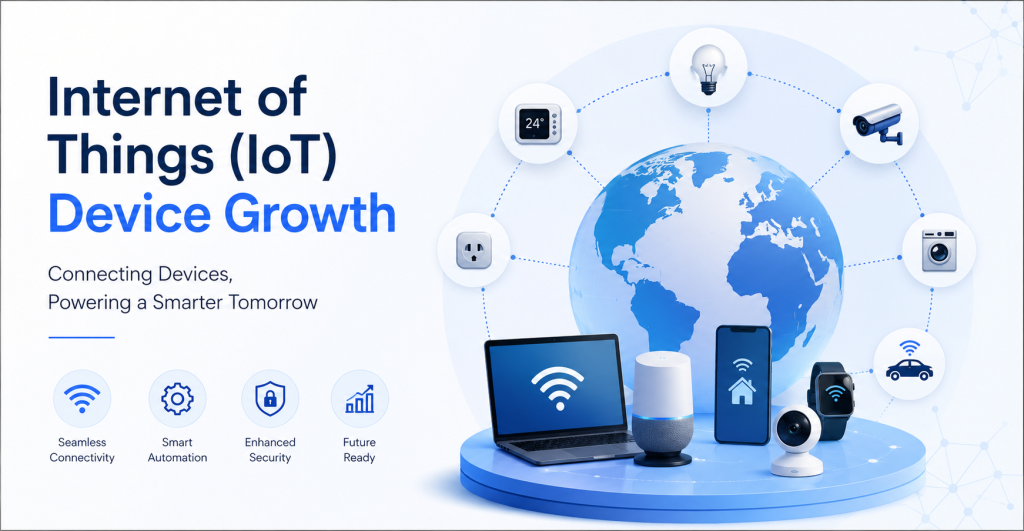

The Internet of Things (IoT) Device Growth trend continues to reshape industries, homes, and cities by connecting billions of smart devices through the internet. From wearable fitness trackers and smart home appliances to industrial sensors and connected vehicles, IoT technology is becoming an essential part of everyday life. Advances in 5G connectivity, artificial intelligence (AI), cloud computing, and edge computing are accelerating the deployment of connected devices worldwide. As organizations increasingly rely on real-time data and automation, IoT devices are playing a critical role in improving operational efficiency, customer experiences, and decision-making across multiple sectors.
Rapid Expansion Across Industries
IoT adoption is no longer limited to consumer electronics. Manufacturing companies use connected sensors to monitor machinery performance and predict maintenance requirements. Healthcare providers utilize wearable devices for remote patient monitoring, while logistics companies deploy IoT-enabled tracking systems to optimize supply chains.
Retail businesses are leveraging smart shelves, inventory sensors, and customer analytics to enhance shopping experiences. Agriculture has also embraced IoT through precision farming technologies that monitor soil conditions, weather patterns, and irrigation systems.
This widespread adoption demonstrates how connected technologies are becoming the backbone of digital transformation.
5G Networks Accelerate Device Connectivity
The rollout of 5G networks is significantly boosting IoT deployment by providing faster data transmission, lower latency, and greater network capacity.
Unlike previous wireless generations, 5G enables millions of devices to communicate simultaneously without compromising performance. This capability supports large-scale smart city projects, autonomous transportation systems, and industrial automation.
The combination of IoT and 5G is creating opportunities for businesses to implement real-time monitoring systems that improve productivity while reducing operational costs.
Artificial Intelligence Enhances Smart Devices
Artificial intelligence has become a key component of modern IoT ecosystems. AI algorithms analyze massive amounts of data generated by connected devices, enabling predictive maintenance, intelligent automation, and personalized user experiences.
Smart home assistants learn user preferences, industrial equipment predicts potential failures before they occur, and healthcare wearables continuously monitor patient health indicators.
Machine learning models running at the network edge allow devices to process information locally, reducing response times while improving privacy and security.
IoT Device Growth Statistics
| IoT Industry Indicator | Recent Trend |
|---|---|
| Connected devices worldwide | Growing rapidly every year |
| Smart home adoption | Strong global expansion |
| Industrial IoT implementation | Increasing across manufacturing |
| Connected healthcare devices | Rising steadily |
| Smart city deployments | Expanding worldwide |
Industry Adoption Continues to Grow
Several sectors are experiencing remarkable IoT adoption.
Healthcare is expanding telemedicine services through wearable monitoring devices that track heart rate, blood pressure, glucose levels, and physical activity.
Manufacturing companies are implementing Industrial IoT (IIoT) solutions to monitor production equipment, reduce downtime, and optimize energy consumption.
Transportation organizations utilize connected vehicles and fleet management systems to improve route planning, vehicle diagnostics, and fuel efficiency.
Energy providers deploy smart meters and grid monitoring systems to optimize electricity distribution and reduce energy waste.
Edge Computing Supports Real-Time Processing
Traditional cloud computing remains essential for IoT, but edge computing is becoming increasingly important.
Instead of transmitting every piece of data to centralized servers, edge devices process information closer to where it is generated. This reduces latency, minimizes bandwidth usage, and enables faster decision-making.
Industries requiring immediate responses, such as autonomous vehicles, manufacturing automation, and emergency healthcare systems, particularly benefit from edge computing technologies.
Security Remains a Top Priority
As billions of devices connect to the internet, cybersecurity has become one of the industry’s biggest challenges.
Organizations are investing in stronger authentication methods, encrypted communications, zero-trust security architectures, and AI-powered threat detection systems to protect connected environments.
Manufacturers are also designing IoT devices with security built into hardware and software from the beginning rather than adding protection later.
Regulatory agencies worldwide continue introducing cybersecurity standards to improve the safety of connected ecosystems.
Emerging Opportunities
The future of IoT presents significant opportunities across multiple industries.
Key growth areas include:
- Smart cities
- Connected healthcare
- Industrial automation
- Precision agriculture
- Autonomous transportation
- Smart energy management
- Environmental monitoring
- Connected retail
- Intelligent supply chains
- Smart buildings
As organizations continue investing in digital infrastructure, IoT technologies will become increasingly integrated into daily operations.
Consumer Demand Drives Innovation
Consumers are embracing smart technologies that simplify everyday life.
Voice-controlled assistants, connected security cameras, smart thermostats, wearable health devices, and intelligent appliances have become increasingly common in homes worldwide.
Manufacturers continue introducing innovative products with improved interoperability, allowing multiple smart devices to communicate seamlessly through unified ecosystems.
This growing consumer demand encourages further investment in research, development, and product innovation.
Future Outlook
The future of IoT device growth appears exceptionally promising. Continued expansion of 5G infrastructure, improvements in artificial intelligence, advancements in semiconductor technologies, and greater cloud integration will accelerate global IoT adoption.
Businesses will increasingly rely on connected ecosystems to improve operational efficiency, reduce costs, enhance customer experiences, and support sustainability initiatives.
As interoperability standards mature and cybersecurity continues to improve, IoT devices will become even more reliable and accessible for businesses and consumers alike.
Conclusion
Internet of Things (IoT) devices are transforming industries through intelligent connectivity, real-time data collection, and automated decision-making. Rapid advancements in AI, 5G, edge computing, and cloud technologies continue to expand the possibilities for connected ecosystems.
From smart homes and healthcare to manufacturing and transportation, IoT device growth is driving digital transformation across the global economy. Organizations that invest in secure, scalable, and intelligent IoT solutions today will be well-positioned to capitalize on the next generation of connected innovation.