
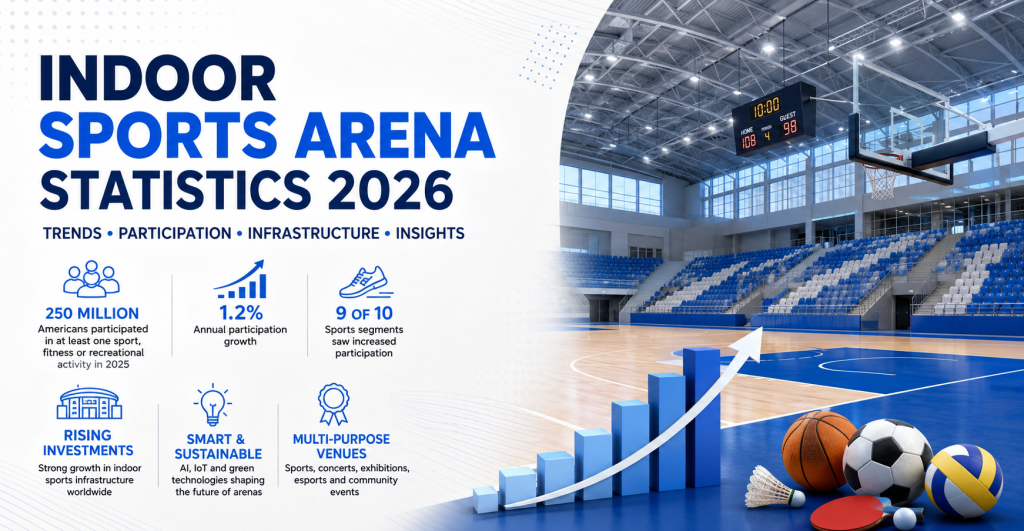

Indoor sports arenas have become an essential part of the global sports and recreation ecosystem. From basketball courts and badminton halls to volleyball complexes, indoor football fields, ice rinks, and multi-purpose stadiums, these venues support professional competitions, grassroots sports, fitness programs, esports events, concerts, and community activities.
Growing investments in sports infrastructure, rising health awareness, increasing urbanization, and the popularity of year-round recreational activities are driving demand for indoor sports arenas worldwide. Governments and private organizations are also expanding sports facilities to encourage participation, host international events, and improve public health.
This article highlights the latest indoor sports arena statistics, participation trends, infrastructure developments, and industry insights.
Key Indoor Sports Arena Statistics
- Indoor sports facilities are among the fastest-growing segments of sports infrastructure due to year-round usability.
- Basketball, badminton, volleyball, futsal, table tennis, and pickleball are among the most common sports played in indoor arenas.
- Indoor venues are increasingly being designed as multi-purpose facilities capable of hosting sports, concerts, exhibitions, and esports tournaments.
- Smart technologies such as digital ticketing, LED scoreboards, AI-powered security, and energy-efficient lighting are becoming standard features in modern arenas.
- Community sports centers account for a significant share of indoor sports infrastructure globally.
- The Sports & Fitness Industry Association (SFIA) reported that 250 million Americans participated in at least one sport, fitness, or recreational activity in 2025, the highest level since the organization began tracking participation.
- According to the National Sporting Goods Association (NSGA), participation increased across 9 of 10 sports segments, including indoor sports, reflecting continued demand for indoor recreational facilities.
Indoor Sports Arena Industry Statistics
| Statistic | Value |
|---|---|
| Primary Uses | Sports, fitness, concerts, exhibitions, esports |
| Popular Indoor Sports | Basketball, Volleyball, Badminton, Futsal, Pickleball, Table Tennis |
| Major Users | Schools, Universities, Sports Clubs, Municipalities, Professional Teams |
| Common Technologies | Smart lighting, AI security, Digital ticketing, IoT monitoring |
| Fastest Growing Trend | Multi-purpose indoor sports complexes |
Indoor Sports Participation Statistics
Participation remains the biggest driver behind new arena construction.
- Team sports continue to attract millions of participants every year.
- Indoor sports provide weather-independent access, making them popular in urban regions.
- Recreational leagues and youth academies continue expanding globally.
- Pickleball has become one of the fastest-growing indoor sports in North America.
- Volleyball, badminton, basketball, gymnastics, and martial arts continue to experience increasing recreational participation.
According to SFIA:
| Participation Indicator | Latest Figure |
|---|---|
| Americans participating in at least one activity (2025) | 250 million |
| Annual participation growth | 1.2% |
| Core participants | 158.8 million |
Indoor Sports Arena Construction Statistics
Governments and private investors continue expanding sports infrastructure.
Some major construction trends include:
- Multi-sport complexes replacing single-purpose facilities.
- Greater use of modular construction techniques.
- Solar-powered arena developments.
- Sustainable HVAC and ventilation systems.
- Flexible seating configurations for sports and entertainment.
Many cities are investing in community indoor arenas to increase sports accessibility while also generating tourism and local economic activity.
Smart Indoor Arena Statistics
Modern indoor arenas increasingly incorporate digital technologies.
Popular innovations include:
- AI-powered surveillance
- Facial recognition entry systems
- Contactless ticketing
- IoT-based energy management
- Smart LED lighting
- Digital advertising displays
- Real-time crowd analytics
- High-speed Wi-Fi connectivity
These technologies improve operational efficiency while enhancing the fan experience.
Indoor Sports Arena Revenue Drivers
Major revenue sources include:
- Sporting events
- League tournaments
- Concerts
- Conferences
- Corporate events
- Naming rights
- Sponsorships
- Premium seating
- Food and beverage sales
- Merchandise
- Parking fees
Many arenas now operate throughout the year instead of relying solely on seasonal sports schedules.
Sustainability Statistics
New arena developments increasingly prioritize sustainability.
Common environmental initiatives include:
- Solar energy systems
- Rainwater harvesting
- LED lighting
- Energy-efficient cooling systems
- Water recycling
- Sustainable construction materials
- Electric vehicle charging stations
Green-certified sports facilities are becoming more common as cities work toward carbon reduction goals.
Regional Indoor Sports Arena Trends
North America
- High demand for basketball, hockey, volleyball, pickleball, and indoor soccer.
- Significant investment in community recreation centers.
- Growing adoption of smart arena technologies.
Europe
- Strong indoor sports culture across basketball, handball, volleyball, and futsal.
- Increased renovation of aging sports facilities.
- Focus on sustainable arena construction.
Asia-Pacific
- Rapid urbanization driving new arena construction.
- Expansion of badminton, basketball, table tennis, and volleyball facilities.
- Rising government investment in sports infrastructure.
Middle East
- Large-scale sports infrastructure investments.
- Growth in indoor entertainment complexes.
- Hosting international sporting events.
Interesting Indoor Sports Arena Facts
- Indoor arenas can host multiple sports using interchangeable flooring systems.
- Many professional arenas transform from basketball courts into concert venues within hours.
- Climate-controlled environments enable year-round sporting activities regardless of weather conditions.
- Some modern arenas integrate AI systems that monitor crowd movement to improve safety and operations.
- Indoor venues increasingly support both traditional sports and esports competitions.
Future Outlook
The future of indoor sports arenas will be shaped by:
- Smart stadium technologies
- Sustainable construction
- Increased youth sports participation
- Expansion of community recreation centers
- Growing popularity of indoor fitness activities
- Multi-purpose venue development
- Digital fan engagement
- AI-driven facility management
As governments continue promoting healthier lifestyles and cities invest in sports infrastructure, indoor sports arenas are expected to become even more important for recreation, professional competition, and community engagement.
Conclusion
Indoor sports arenas are evolving beyond traditional sports venues into multifunctional community hubs that support athletics, entertainment, wellness, and digital experiences. Rising participation in indoor sports, increasing investments in smart infrastructure, and the demand for sustainable facilities are driving the next phase of growth. With governments, schools, private operators, and sports organizations continuing to expand indoor facilities, these arenas will play a vital role in shaping the future of global sports participation and active lifestyles.