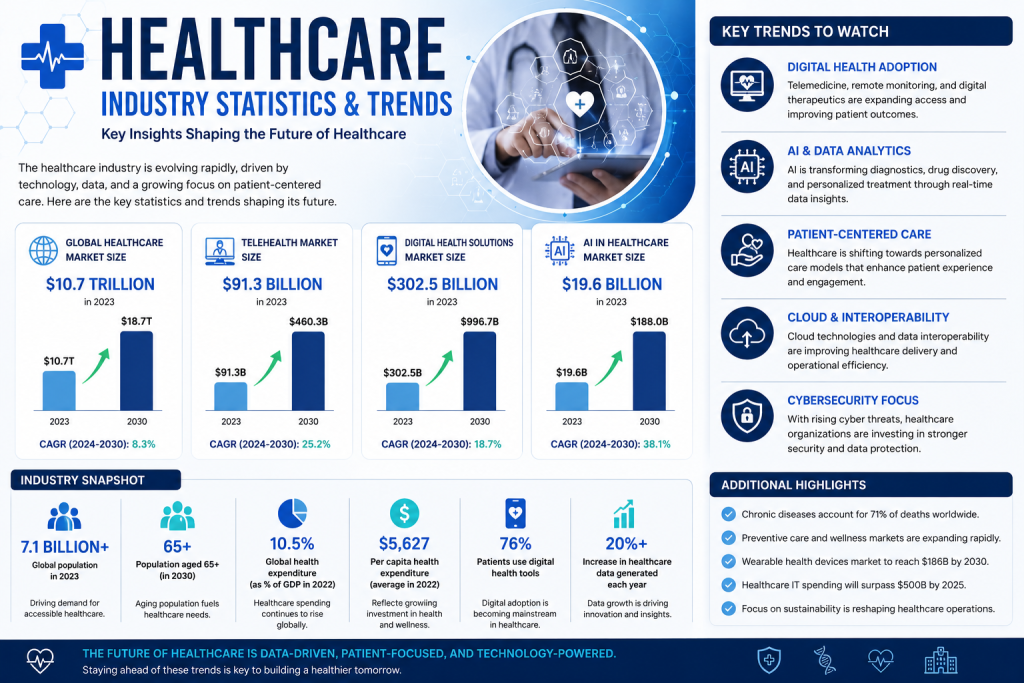

The healthcare industry continues to evolve rapidly as technological innovation, aging populations, and changing patient expectations reshape the global healthcare landscape. In 2026, healthcare is becoming more connected, data-driven, and patient-centered than ever before. Advances in digital health, artificial intelligence (AI), telemedicine, wearable devices, and precision medicine are transforming how healthcare services are delivered while improving accessibility and efficiency.
Healthcare statistics provide valuable insights into these changes, helping governments, healthcare providers, businesses, and investors understand where the industry is headed. From increasing healthcare spending to the widespread adoption of digital technologies, current trends reveal an industry focused on innovation, preventive care, and improved patient outcomes.
Global Healthcare Continues to Expand
Healthcare remains one of the world’s largest and fastest-growing industries. Rising life expectancy, increasing chronic diseases, expanding healthcare infrastructure, and growing awareness of preventive care continue to drive demand for medical services across developed and emerging economies.
Governments are investing in hospitals, medical equipment, healthcare professionals, and public health programs to meet the growing healthcare needs of their populations. At the same time, private healthcare providers are expanding services and adopting new technologies to improve patient experiences and operational efficiency.
Digital Health Is Becoming Mainstream
One of the biggest healthcare trends in 2026 is the rapid adoption of digital health technologies. Hospitals, clinics, and healthcare providers increasingly rely on digital platforms to streamline patient care, manage medical records, and improve communication.
Electronic Health Records (EHRs) have become standard across many healthcare systems, allowing healthcare professionals to securely access patient information and improve coordination between departments.
Mobile health applications are also becoming essential tools for patients, enabling appointment scheduling, medication reminders, fitness tracking, and access to virtual consultations.
Telemedicine Continues Its Strong Growth
Virtual healthcare has become a permanent part of modern medicine. Telemedicine allows patients to consult healthcare professionals remotely using smartphones, tablets, or computers.
This approach reduces travel time, improves access to specialists, and enables continuous care for individuals living in rural or underserved areas. It has also become an effective solution for follow-up appointments, mental health counseling, chronic disease management, and preventive healthcare.
Healthcare providers continue to invest in secure telehealth platforms as patient demand for convenient healthcare services grows.
Artificial Intelligence Is Improving Healthcare
Artificial intelligence is playing a larger role in healthcare every year. AI-powered systems assist doctors by analyzing medical images, detecting disease patterns, predicting patient risks, and supporting clinical decision-making.
Healthcare organizations are also using AI to automate administrative tasks such as appointment scheduling, billing, documentation, and patient triage. These improvements reduce operational costs while allowing healthcare professionals to focus more on patient care.
As AI technology matures, its role in diagnostics, drug discovery, and personalized treatment planning is expected to expand significantly.
Wearable Technology Supports Preventive Care
Wearable health devices have become increasingly popular among consumers seeking to monitor their health in real time. Smartwatches, fitness bands, heart rate monitors, blood oxygen sensors, and glucose monitoring devices provide continuous health information that encourages healthier lifestyles.
These devices allow healthcare providers to monitor patients remotely and identify potential health issues before they become serious. The increasing use of wearable technology is shifting healthcare from reactive treatment toward proactive disease prevention.
Healthcare Data Is Driving Better Decisions
Healthcare organizations generate enormous amounts of data every day. Advanced analytics platforms help transform this information into actionable insights that improve patient care and operational efficiency.
Data analytics supports disease surveillance, hospital resource planning, clinical research, population health management, and personalized treatment strategies. Healthcare leaders increasingly rely on real-time data to make informed decisions and improve healthcare delivery.
The growing importance of healthcare data has also increased demand for cybersecurity solutions that protect sensitive patient information.
Personalized Medicine Is Expanding
Modern healthcare is moving away from one-size-fits-all treatment approaches. Personalized medicine uses patient-specific information—including genetics, medical history, and lifestyle factors—to develop customized treatment plans.
Advances in genomic research and AI-driven analytics allow healthcare providers to recommend therapies that are more effective while reducing unnecessary treatments and adverse side effects.
This patient-centered approach is expected to become increasingly common across oncology, cardiology, rare diseases, and chronic disease management.
Healthcare Workforce Continues to Evolve
Healthcare professionals remain the foundation of the industry, but technology is changing how they work. Automation reduces administrative workloads, while digital tools improve collaboration between physicians, nurses, specialists, and patients.
Continuous training in AI, digital health platforms, cybersecurity, and advanced medical technologies is becoming essential for healthcare workers adapting to a rapidly changing healthcare environment.
Future Outlook
The future of healthcare looks increasingly digital, intelligent, and connected. Artificial intelligence, telemedicine, wearable technology, cloud computing, data analytics, and personalized medicine will continue to reshape healthcare delivery over the coming years.
Healthcare organizations that embrace innovation while maintaining patient privacy, data security, and high-quality care will be best positioned for long-term success. As technology continues to evolve, the healthcare industry will play an even greater role in improving lives, increasing accessibility, and creating more efficient healthcare systems worldwide.
The statistics and trends shaping healthcare in 2026 demonstrate a clear shift toward smarter, faster, and more personalized care. These developments are creating new opportunities for healthcare providers, technology companies, researchers, investors, and patients alike, making healthcare one of the most dynamic industries of the decade.