

The way consumers and businesses exchange money has changed dramatically over the past decade. Digital payments, once considered a convenience, have evolved into the backbone of modern commerce, powering everything from online shopping and mobile banking to contactless retail transactions and peer-to-peer transfers. As smartphones become increasingly ubiquitous and financial technology continues to advance, digital payment ecosystems are expanding at an unprecedented pace.
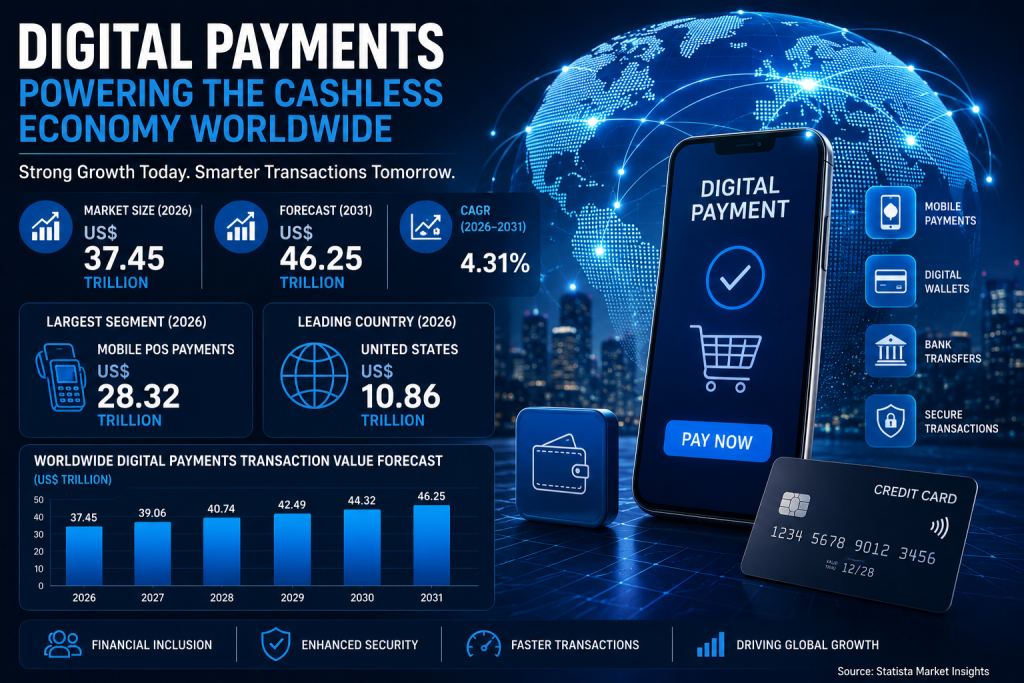
The worldwide digital payments market is projected to generate a total transaction value of US$37.45 trillion in 2026. The market is expected to grow at a compound annual growth rate (CAGR) of 4.31% between 2026 and 2031, reaching an estimated US$46.25 trillion by 2031. Mobile POS Payments remain the largest segment, accounting for US$28.32 trillion in projected transaction value during 2026, while the United States leads globally with an estimated US$10.86 trillion in transaction value.
These figures demonstrate that digital payments are no longer simply replacing cash—they are redefining how economies function, enabling faster transactions, broader financial inclusion, and entirely new business models across virtually every industry.
Key Market Statistics
| Metric | Value |
|---|---|
| Projected Transaction Value (2026) | US$37.45 Trillion |
| Forecast Transaction Value (2031) | US$46.25 Trillion |
| CAGR (2026–2031) | 4.31% |
| Largest Market Segment | Mobile POS Payments |
| Mobile POS Value (2026) | US$28.32 Trillion |
| Leading Country | United States |
| U.S. Transaction Value (2026) | US$10.86 Trillion |
Source: Statista Market Insights
Digital Payments Continue to Expand Across Every Industry
Digital payments have become an essential component of the global digital economy. Retailers, financial institutions, healthcare providers, transportation companies, governments, and e-commerce platforms increasingly rely on digital payment infrastructure to improve efficiency and customer experience.
Several factors continue to accelerate adoption, including:
- Rapid smartphone penetration
- Expansion of e-commerce
- Contactless payment adoption
- Growth of digital wallets
- Buy Now, Pay Later (BNPL) services
- Real-time payment networks
- Improved payment security
Consumers increasingly expect frictionless checkout experiences, while businesses benefit from faster settlements, improved cash flow, and richer customer insights.
Digital Payment Ecosystem
| Payment Method | Growth Trend |
| Digital Wallets | Very High |
| Mobile POS Payments | Very High |
| Account-to-Account (A2A) | High |
| Credit & Debit Cards | Stable Growth |
| Buy Now, Pay Later | Rapid Growth |
| Cryptocurrency Payments | Emerging |
The continued diversification of payment methods allows consumers greater flexibility while encouraging businesses to integrate multiple payment options into their digital platforms.
Transaction Value Outlook
Mobile Payments Are Driving the Market
Among all payment categories, mobile point-of-sale (POS) payments continue to dominate transaction volumes. Consumers increasingly prefer smartphones over physical cards, particularly in markets where QR-code payments, NFC technology, and digital wallets have become mainstream.
Payment providers are also integrating loyalty programs, biometric authentication, and AI-powered fraud prevention into mobile payment platforms, further enhancing user confidence and convenience.
The rapid expansion of digital wallets such as Apple Pay, Google Pay, Alipay, WeChat Pay, and numerous regional fintech platforms continues to reshape consumer payment behavior across both developed and emerging economies.
Regional Momentum Continues to Build
While North America and Europe remain mature digital payment markets, Asia-Pacific continues driving global innovation through large-scale mobile payment adoption and digital-first consumer behavior.
Meanwhile, Latin America, Africa, and Southeast Asia are experiencing accelerated growth as smartphone adoption, internet connectivity, and financial inclusion initiatives expand access to digital financial services.
Government-backed payment systems, open banking initiatives, and fintech investments are expected to further strengthen digital payment infrastructure worldwide.
Challenges That Still Need Attention
Despite remarkable growth, the industry continues facing several important challenges.
Cybersecurity remains a top priority as payment providers strengthen fraud detection capabilities against increasingly sophisticated cyber threats. Regulatory compliance also varies significantly across jurisdictions, requiring payment companies to adapt to evolving data privacy, anti-money laundering, and financial security regulations.
In addition, ensuring equal access to digital financial services remains an important objective, particularly in regions with limited digital infrastructure or banking access.
Future Outlook
Artificial intelligence, embedded finance, blockchain technology, open banking, and real-time payment networks are expected to shape the next generation of digital payment innovation. Financial institutions and fintech companies are increasingly investing in intelligent payment ecosystems capable of delivering faster, safer, and more personalized customer experiences.
As businesses continue digitizing operations and consumers increasingly embrace cashless transactions, digital payments will remain one of the most dynamic sectors within the global financial technology landscape.
Conclusion
The digital payments market has evolved into one of the most influential pillars of the global digital economy. With worldwide transaction values projected to exceed US$46 trillion by 2031, the sector is poised to continue transforming how consumers shop, businesses operate, and financial institutions deliver services. Organizations that invest in secure, scalable, and innovative payment technologies will be best positioned to capitalize on the accelerating transition toward a fully digital financial ecosystem.