
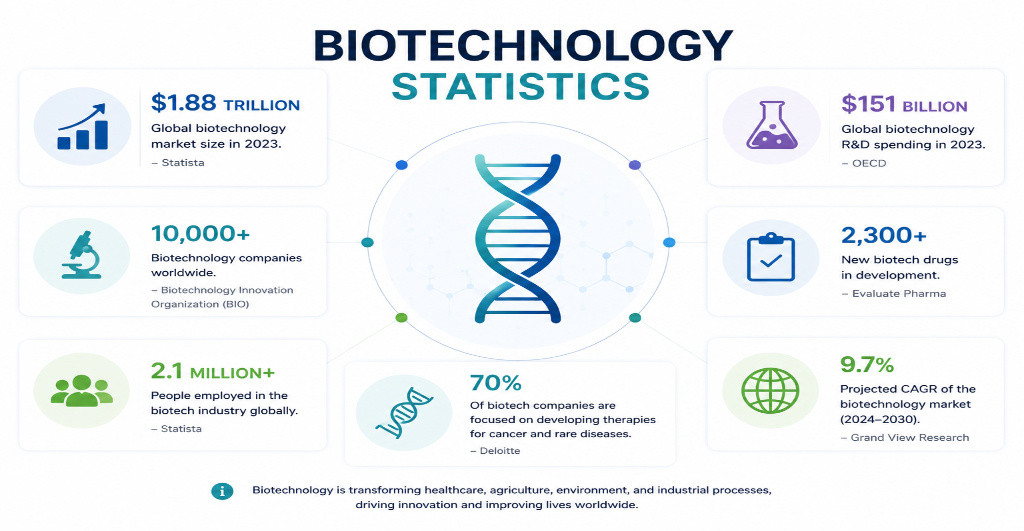

Biotechnology has become one of the fastest-growing innovation sectors, transforming healthcare, agriculture, pharmaceuticals, industrial manufacturing, and environmental sustainability. Advances in gene editing, synthetic biology, precision medicine, biopharmaceuticals, and artificial intelligence are accelerating discoveries that were once considered impossible. As governments and private investors continue to increase funding for biotechnology research, the industry is experiencing unprecedented growth and creating new opportunities for businesses, researchers, and investors.
Understanding the latest biotechnology statistics provides valuable insight into how rapidly the sector is evolving. The following statistics highlight the industry’s growth, investment trends, technological breakthroughs, and future market opportunities.
Why Biotechnology Is Growing Rapidly
The biotechnology industry is benefiting from rising healthcare demand, increasing chronic disease prevalence, expanding genomic research, and breakthroughs in molecular biology. Pharmaceutical companies are investing heavily in biologics and personalized medicine, while agricultural biotechnology is improving crop productivity and sustainability.
Artificial intelligence, cloud computing, and automation are also accelerating biotechnology research by enabling faster drug discovery, advanced diagnostics, and efficient laboratory operations.
Top Biotechnology Statistics You Should Know
1. Biopharmaceuticals Dominate Drug Development
More than half of the medicines currently under development globally are biologics, including monoclonal antibodies, gene therapies, cell therapies, and recombinant proteins. These treatments are transforming the management of cancer, autoimmune disorders, and rare diseases.
2. Gene Editing Investment Continues to Rise
CRISPR and other gene-editing technologies are attracting billions of dollars in research funding as scientists develop treatments for inherited diseases, genetic disorders, and certain cancers.
3. Personalized Medicine Is Expanding
Precision medicine uses genetic information to tailor treatments to individual patients. Healthcare providers are increasingly adopting genomic testing to improve treatment effectiveness while reducing adverse drug reactions.
4. AI Is Accelerating Drug Discovery
Artificial intelligence can analyze millions of molecular compounds significantly faster than traditional research methods. Pharmaceutical companies now use AI to identify promising drug candidates, predict clinical trial outcomes, and optimize research pipelines.
5. Biotechnology Venture Capital Remains Strong
Global biotechnology startups continue attracting significant venture capital investment, particularly in synthetic biology, gene therapy, digital health, and precision diagnostics.
6. Cell and Gene Therapy Market Is Growing Rapidly
Regenerative medicine is becoming one of biotechnology’s fastest-growing segments. Cell-based therapies and gene therapies are offering new treatment options for diseases previously considered untreatable.
7. Agricultural Biotechnology Is Improving Food Security
Genetically improved crops help farmers increase yields, reduce pesticide use, and improve resilience against drought, pests, and changing climate conditions.
8. DNA Sequencing Costs Continue to Decline
Advancements in next-generation sequencing technologies have dramatically reduced genome sequencing costs, making genetic testing increasingly accessible for healthcare providers and researchers.
9. Synthetic Biology Is Creating New Industries
Synthetic biology enables scientists to engineer microorganisms that produce sustainable chemicals, biofuels, pharmaceuticals, food ingredients, and specialty materials with improved efficiency.
10. Biotechnology Supports Sustainable Manufacturing
Industrial biotechnology is helping manufacturers replace petroleum-based production with renewable biological processes, reducing carbon emissions while supporting circular economy initiatives.
Emerging Biotechnology Trends
Several innovations are expected to shape the industry’s future:
- AI-powered drug discovery platforms
- CRISPR-based gene editing
- Precision medicine and companion diagnostics
- Synthetic biology applications
- Personalized cancer therapies
- RNA therapeutics
- Microbiome-based treatments
- Biomanufacturing automation
- Digital laboratory technologies
- Sustainable agricultural biotechnology
These innovations are expanding biotechnology beyond healthcare into food production, environmental protection, renewable energy, and industrial manufacturing.
Investment Opportunities
Growing demand for innovative healthcare solutions is creating attractive investment opportunities across the biotechnology ecosystem. High-growth segments include:
- Gene therapy companies
- Cell therapy developers
- Biopharmaceutical manufacturers
- Genomic sequencing providers
- AI-driven biotechnology platforms
- Agricultural biotechnology firms
- Diagnostic technology companies
- Synthetic biology startups
- Bioprocessing equipment manufacturers
- Laboratory automation providers
Government research funding and private-sector investment continue supporting innovation, making biotechnology one of the most dynamic sectors in the global economy.
Challenges Facing Biotechnology
Despite its rapid progress, the biotechnology industry faces several challenges. High research and development costs, lengthy clinical trial processes, regulatory approval requirements, intellectual property protection, manufacturing scalability, and ethical considerations remain important issues.
Companies must also address data privacy concerns associated with genomic information while ensuring equitable access to advanced biotechnology treatments.
Future Outlook
The future of biotechnology looks exceptionally promising as scientific breakthroughs continue transforming medicine, agriculture, and industrial production. Artificial intelligence, gene editing, synthetic biology, and precision healthcare are expected to redefine disease treatment, improve food security, and support more sustainable manufacturing practices.
As innovation accelerates, biotechnology statistics will continue reflecting strong investment, expanding research activity, and growing commercial adoption across multiple industries. Organizations that embrace these technologies early will be well-positioned to capitalize on one of the world’s most influential innovation sectors.