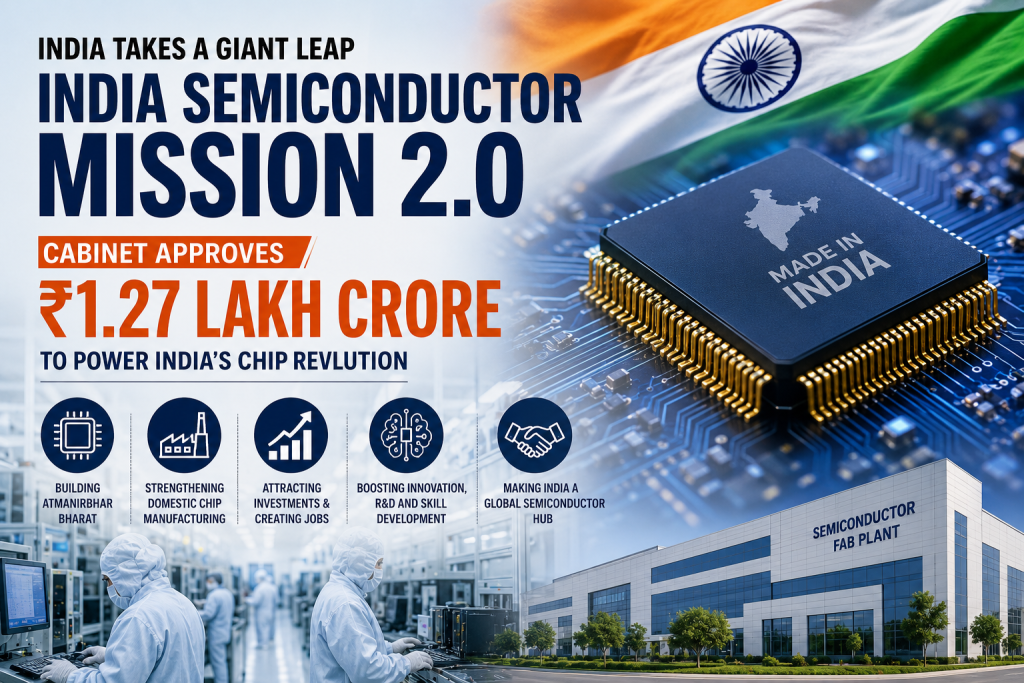

The Indian government has taken another major step toward establishing the country as a global semiconductor powerhouse after the Union Cabinet approved India Semiconductor Mission (ISM) 2.0 with an outlay of ₹1.27 lakh crore. The ambitious programme is designed to strengthen domestic chip manufacturing, expand the semiconductor supply chain, support indigenous innovation, and reduce India’s dependence on imported semiconductors.
Alongside ISM 2.0, the Cabinet also approved a ₹62,500 crore Mobile Phone Manufacturing Scheme (MPMS), underscoring India’s broader strategy to deepen electronics manufacturing under the “Make in India” initiative. Together, these initiatives represent one of the country’s largest technology and manufacturing investments, with a combined allocation exceeding ₹2.19 lakh crore across multiple strategic sectors.
Government Doubles Down on India’s Semiconductor Ambitions
Semiconductors have become the backbone of the global digital economy, powering everything from smartphones and automobiles to artificial intelligence, cloud computing, telecommunications, and defense systems.
Recognizing the strategic importance of chip manufacturing, the Indian government has significantly expanded its semiconductor vision under ISM 2.0. The programme builds upon the foundation laid by the first India Semiconductor Mission while broadening support across the semiconductor value chain.
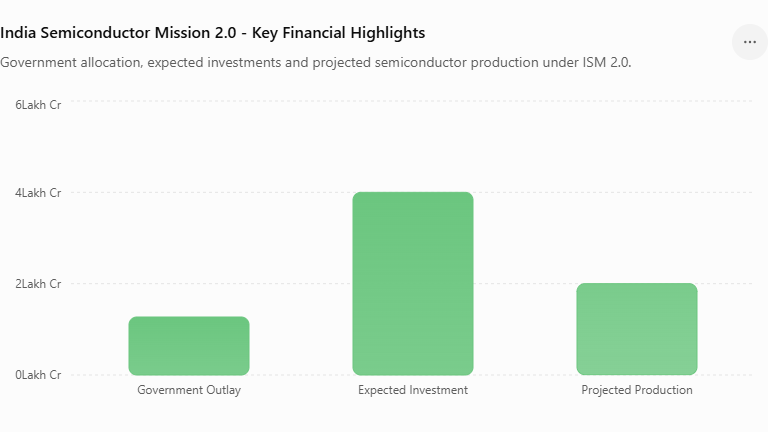
The government expects the initiative to attract nearly ₹4 lakh crore in investments while generating semiconductor production valued at approximately ₹2 lakh crore during the implementation period.
India Moves Beyond Chip Manufacturing
Unlike the original mission, ISM 2.0 adopts a more comprehensive approach by supporting multiple segments of the semiconductor ecosystem.
The initiative focuses on:
- Semiconductor fabrication facilities
- Assembly, testing, marking and packaging (ATMP)
- Chip design and intellectual property development
- Semiconductor materials
- Manufacturing equipment
- Research, innovation and talent development
Officials believe strengthening every layer of the supply chain will improve India’s competitiveness while reducing vulnerabilities associated with global semiconductor shortages.
Key Highlights of India Semiconductor Mission 2.0
| Initiative | Details |
|---|---|
| Total Government Outlay | ₹1.27 lakh crore |
| Expected Investments | Around ₹4 lakh crore |
| Estimated Semiconductor Production | ₹2 lakh crore |
| Primary Objective | Build a complete semiconductor manufacturing ecosystem |
| Key Focus Areas | Chip fabrication, ATMP, design, materials, equipment, talent development |
Government allocation, expected investments and projected semiconductor production under ISM 2.0.