
The explosive growth of AI applications, cloud computing, and hyperscale infrastructure is pushing global electricity consumption to record levels.
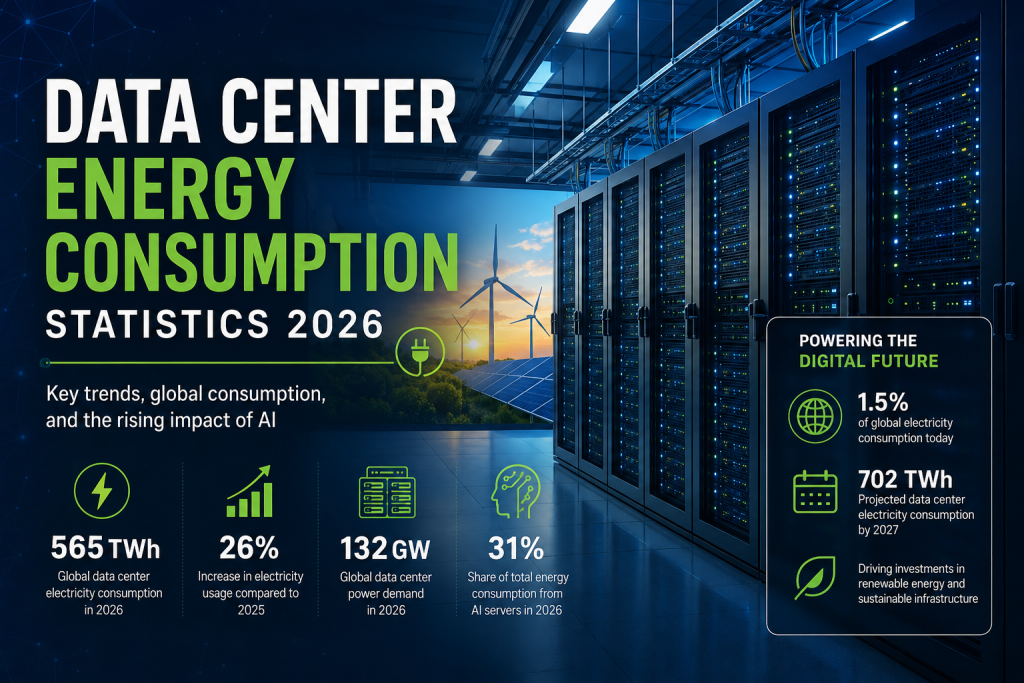
Industry forecasts show that data centers worldwide will consume 565 TWh of electricity in 2026, up from 447 TWh in 2025. This increase reflects one of the fastest annual growth rates ever recorded for the industry.
Global Data Center Electricity Consumption
| Year | Electricity Consumption (TWh) | Annual Growth |
|---|---|---|
| 2025 | 447 | 15.5% |
| 2026 | 565 | 26.4% |
| 2027 (Forecast) | 702 | 24.1% |
Source: Gartner, 2026
The rapid increase reflects expanding AI workloads, larger hyperscale campuses, and growing enterprise cloud adoption across North America, Europe, and Asia-Pacific.
AI Is Becoming the Largest Consumer of Data Center Power
Artificial intelligence is transforming data center architecture.
Unlike traditional servers, AI infrastructure relies on high-performance GPUs and accelerators that require significantly higher power densities. As organizations deploy generative AI models, AI clusters consume substantially more electricity than conventional computing systems.
According to Gartner:
- AI servers will consume 175 TWh in 2026.
- Conventional servers will consume 195 TWh.
- AI will represent 31% of total data center electricity consumption.
- AI server electricity consumption is expected to exceed conventional servers in 2027.
Electricity Consumption by Data Center Segment
Energy use is distributed across computing hardware and supporting infrastructure such as cooling systems and power equipment.
Data Center Electricity Consumption by Segment (2026)
| Segment | Electricity Consumption (TWh) |
|---|---|
| Conventional Servers | 195 |
| AI-Optimized Servers | 175 |
| Cooling & Infrastructure | 195 |
| Total | 565 |
Source: Gartner, 2026
Cooling remains one of the largest operational energy expenses, especially for AI facilities that generate significantly more heat.
Data Centers Are Becoming Major Electricity Consumers
Although data centers currently account for a relatively small share of global electricity consumption, their growth rate far exceeds that of most other industries.
Research indicates that data centers now represent approximately 1.5% of worldwide electricity demand, with forecasts suggesting this figure could nearly double by 2030 as AI adoption accelerates.
Countries with the largest concentration of hyperscale facilities—including the United States, China, Ireland, Singapore, and several Nordic nations—are expected to experience the greatest increases in electricity demand.
AI Infrastructure Is Driving New Grid Investments
Electricity has become one of the biggest constraints for AI expansion.
Global data center power demand is forecast to increase from 104 GW in 2025 to 132 GW in 2026, representing approximately 27% annual growth.
By 2030, worldwide power demand could reach 290 GW, requiring utilities and governments to expand generation capacity, transmission infrastructure, and renewable energy investments.
Cooling Systems Consume Massive Amounts of Energy
Powering servers is only part of the energy equation.
Modern data centers require extensive cooling systems to maintain optimal operating temperatures. As AI servers become denser and more power-intensive, traditional air cooling is increasingly being replaced by:
- Liquid cooling
- Direct-to-chip cooling
- Immersion cooling
- Advanced airflow optimization
These technologies improve energy efficiency while reducing operational costs over the long term.
Renewable Energy Is Becoming a Strategic Priority
Leading hyperscale cloud providers continue investing heavily in renewable electricity procurement.
Major operators increasingly power new facilities using:
- Solar energy
- Wind power
- Hydroelectricity
- Nuclear power purchase agreements
- Battery energy storage systems
These investments help reduce carbon emissions while meeting corporate sustainability commitments.
Regional Power Grids Face Growing Pressure
The concentration of hyperscale data centers in specific regions is creating localized electricity challenges.
Utilities in several markets are reporting increased demand driven primarily by AI infrastructure, prompting investments in:
- Grid modernization
- High-voltage transmission
- Flexible power generation
- Energy storage
- Demand response programs
Recent reports also indicate that electricity demand from data centers is contributing to record peak loads in some U.S. power markets.
Sustainability Is Becoming a Competitive Advantage
Energy efficiency has become one of the most important competitive metrics for data center operators.
Organizations increasingly monitor:
- Power Usage Effectiveness (PUE)
- Water Usage Effectiveness (WUE)
- Carbon intensity
- Renewable energy percentage
- Server utilization
- Cooling efficiency
Operators with lower operating costs and higher energy efficiency are better positioned to support expanding AI workloads sustainably.
Future Outlook
Data center electricity demand is expected to continue rising throughout the remainder of the decade.
Industry forecasts suggest:
- AI infrastructure will become the dominant driver of electricity growth.
- Power availability will increasingly determine where new data centers are built.
- Renewable energy integration will accelerate.
- Liquid cooling technologies will become mainstream.
- Governments and utilities will invest more heavily in grid expansion to accommodate digital infrastructure.
Conclusion
The latest Data Center Energy Consumption Statistics demonstrate how rapidly digital infrastructure is reshaping global electricity demand. With worldwide consumption projected to reach 565 TWh in 2026 and AI workloads becoming the fastest-growing source of energy use, the industry is entering a new era where computing power and electricity availability are closely intertwined.
As organizations continue expanding AI capabilities, success will increasingly depend on balancing computational performance with energy efficiency, renewable power adoption, and sustainable infrastructure development.