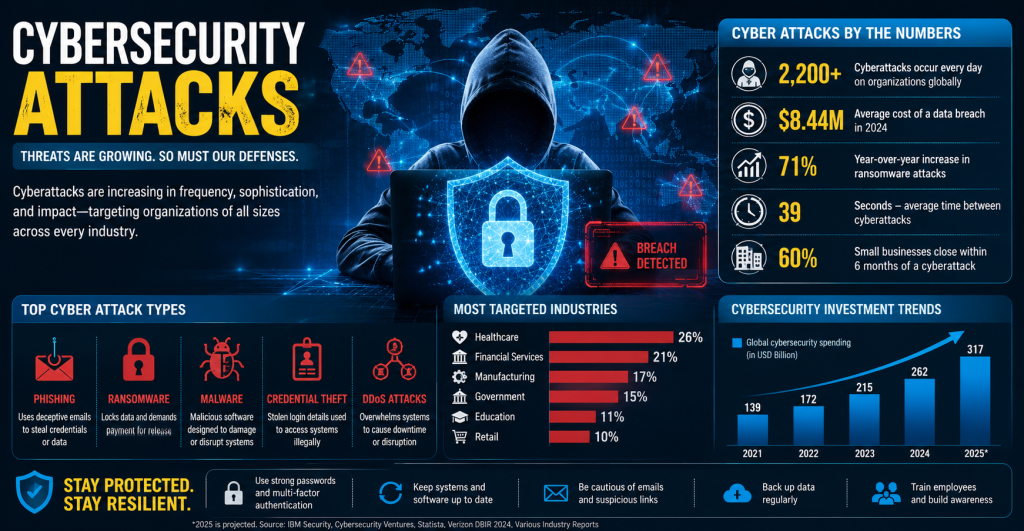

As businesses, governments, and individuals continue to embrace digital transformation, cybersecurity attacks have become one of the fastest-growing global concerns. From ransomware incidents and phishing campaigns to cloud security breaches and AI-powered cybercrime, organizations worldwide are investing heavily in cybersecurity to protect sensitive information and maintain business continuity.
Recent statistics indicate that cyberattacks are becoming more frequent, sophisticated, and financially damaging. Attackers are increasingly targeting critical infrastructure, healthcare systems, financial institutions, manufacturing companies, and small businesses, demonstrating that no sector is immune from digital threats. As technology advances, cybersecurity has evolved from an IT function into a strategic business priority.
The Rising Scale of Cybersecurity Threats
The digital economy has created unprecedented opportunities for innovation, but it has also expanded the attack surface available to cybercriminals. Organizations now manage massive volumes of sensitive data across cloud platforms, remote work environments, connected devices, and artificial intelligence applications.
Cybercriminals exploit vulnerabilities through various attack methods, including ransomware, phishing emails, credential theft, malware infections, insider threats, and distributed denial-of-service (DDoS) attacks. The growing use of connected devices and Internet of Things (IoT) technologies has introduced additional security challenges, requiring organizations to strengthen endpoint protection and network monitoring.
Security experts emphasize that attackers are increasingly automating their operations, enabling them to launch large-scale attacks against thousands of targets simultaneously.
Global Cybersecurity Statistics
The cybersecurity landscape continues to evolve rapidly as organizations respond to increasingly complex threats.
| Cybersecurity Metric | Latest Insight |
|---|---|
| Global cybercrime cost | Expected to exceed USD 10 trillion annually in coming years |
| Most common attack method | Phishing remains one of the leading initial attack vectors |
| Fastest-growing threat | Ransomware attacks continue to increase globally |
| Most targeted sectors | Healthcare, finance, government, manufacturing, and education |
| Primary security investment | Cloud security and Zero Trust architecture |
These figures demonstrate why cybersecurity spending continues to increase across both public and private sectors.
Artificial Intelligence Is Changing Cybersecurity
Artificial intelligence is transforming both cyber defense and cybercrime.
Security teams now use AI-powered platforms to monitor network traffic, identify suspicious behavior, detect malware, and automate incident response. Machine learning algorithms analyze billions of security events in real time, allowing organizations to identify threats before they cause significant damage.
However, cybercriminals are also using AI to improve phishing attacks, generate convincing fraudulent messages, automate vulnerability discovery, and bypass traditional security controls.
This technological competition has accelerated innovation across the cybersecurity industry as organizations seek smarter methods to defend increasingly complex digital environments.
Ransomware Continues to Dominate Headlines
Ransomware remains one of the most damaging forms of cybercrime worldwide. Attackers encrypt organizational data and demand payment for its release, often threatening to publish sensitive information if victims refuse to comply.
Modern ransomware groups operate like professional businesses, offering affiliate programs, technical support, and sophisticated negotiation strategies. Many attacks now involve double extortion, where criminals both encrypt data and steal confidential information before demanding payment.
Organizations are responding by improving backup strategies, implementing multi-factor authentication, segmenting networks, and conducting regular cybersecurity awareness training.
Cloud Security Becomes a Business Priority
Cloud computing has transformed modern business operations, but it has also introduced new cybersecurity responsibilities.
As companies migrate applications and sensitive information to cloud platforms, securing digital assets requires continuous monitoring, identity management, encryption, and access control.
Zero Trust security frameworks are becoming increasingly popular because they verify every user and device before granting system access. Rather than assuming users inside a network are trustworthy, Zero Trust continuously validates identities throughout every digital interaction.
This proactive approach helps reduce the risk of unauthorized access and insider threats.
Cybersecurity Spending Continues to Grow
Organizations worldwide continue expanding cybersecurity budgets as digital threats become more sophisticated.
| Security Investment Area | Growing Focus |
|---|---|
| Cloud Security | Protecting cloud-based applications and data |
| Endpoint Protection | Securing laptops, mobile devices, and IoT equipment |
| Identity & Access Management | Strong authentication and user verification |
| Security Operations Centers | Continuous threat monitoring |
| AI Security Platforms | Automated detection and response |
| Employee Awareness Training | Reducing phishing and human error |
Businesses increasingly recognize that cybersecurity investments help protect customer trust, operational continuity, regulatory compliance, and long-term business resilience.
Human Error Remains a Major Risk
Despite advances in cybersecurity technology, human error continues to contribute significantly to successful cyberattacks.
Employees may unknowingly click malicious email links, reuse weak passwords, download infected attachments, or disclose sensitive information through social engineering attacks.
Cybersecurity awareness programs are becoming an essential component of organizational security strategies. Regular employee training, phishing simulations, password management policies, and multi-factor authentication significantly reduce security risks.
Creating a security-conscious workplace culture is now considered just as important as deploying advanced cybersecurity software.
Emerging Technologies Are Reshaping Digital Security
Several emerging technologies are expected to influence cybersecurity over the next decade.
Quantum computing may eventually require organizations to adopt quantum-resistant encryption methods. Blockchain technologies offer new possibilities for secure identity verification and tamper-resistant record management. AI-powered autonomous security systems continue improving threat detection capabilities while reducing response times.
Meanwhile, governments worldwide are introducing stricter cybersecurity regulations designed to improve critical infrastructure protection, strengthen data privacy, and encourage responsible cyber risk management.
These developments are creating opportunities for cybersecurity software vendors, cloud providers, consulting firms, and managed security service providers.
Looking Ahead
Cybersecurity attacks are becoming more sophisticated as digital technologies continue transforming businesses and everyday life. Artificial intelligence, cloud computing, connected devices, and remote work environments have created tremendous opportunities for innovation—but they have also expanded the scope of cyber threats.
Organizations that invest in proactive cybersecurity strategies, employee education, advanced threat detection, and resilient digital infrastructure will be better positioned to navigate the evolving threat landscape. As cyber risks continue to grow, cybersecurity will remain one of the most critical priorities for governments, enterprises, and individuals alike.
Protecting digital assets is no longer simply an IT responsibility—it is a fundamental requirement for maintaining trust, ensuring operational continuity, and supporting the future of the global digital economy.