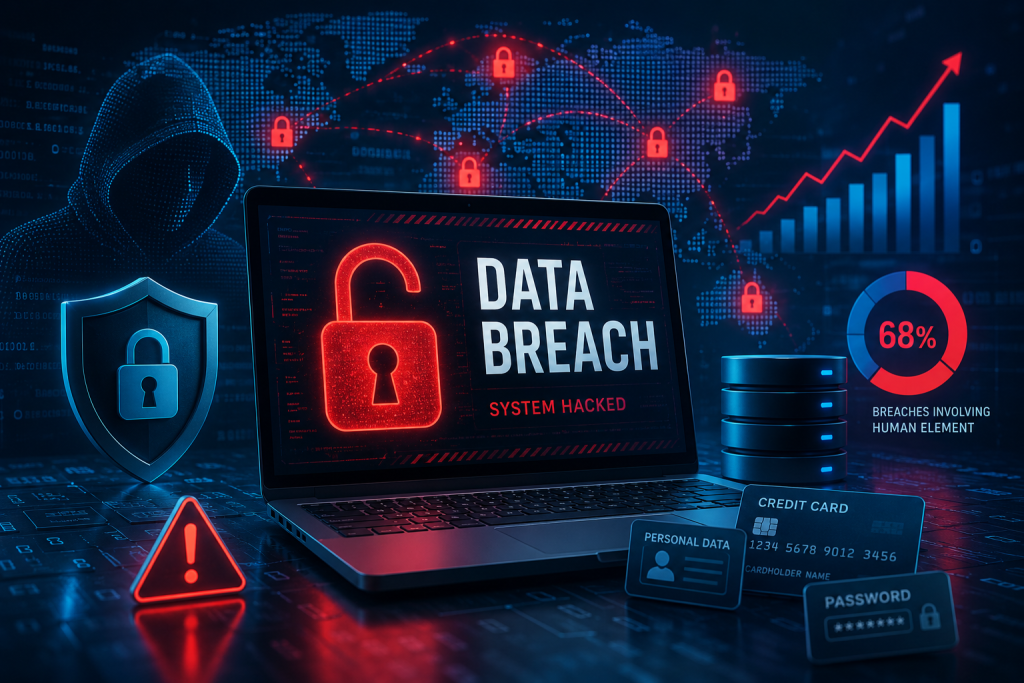

Every second, businesses around the world exchange millions of emails, process thousands of online transactions, and store vast amounts of customer information in digital systems. While this digital transformation has unlocked incredible opportunities, it has also created one of the biggest challenges facing organizations today—data breaches.
A single cybersecurity incident can expose sensitive customer records, interrupt operations, trigger regulatory investigations, and damage a company’s reputation for years. From multinational corporations to small businesses, no organization is completely immune.
The latest data breach statistics paint a clear picture: cybercrime is becoming more sophisticated, attacks are happening more frequently, and the financial impact continues to rise. Whether you’re a business owner, IT professional, or cybersecurity enthusiast, these statistics provide valuable insight into the current threat landscape.
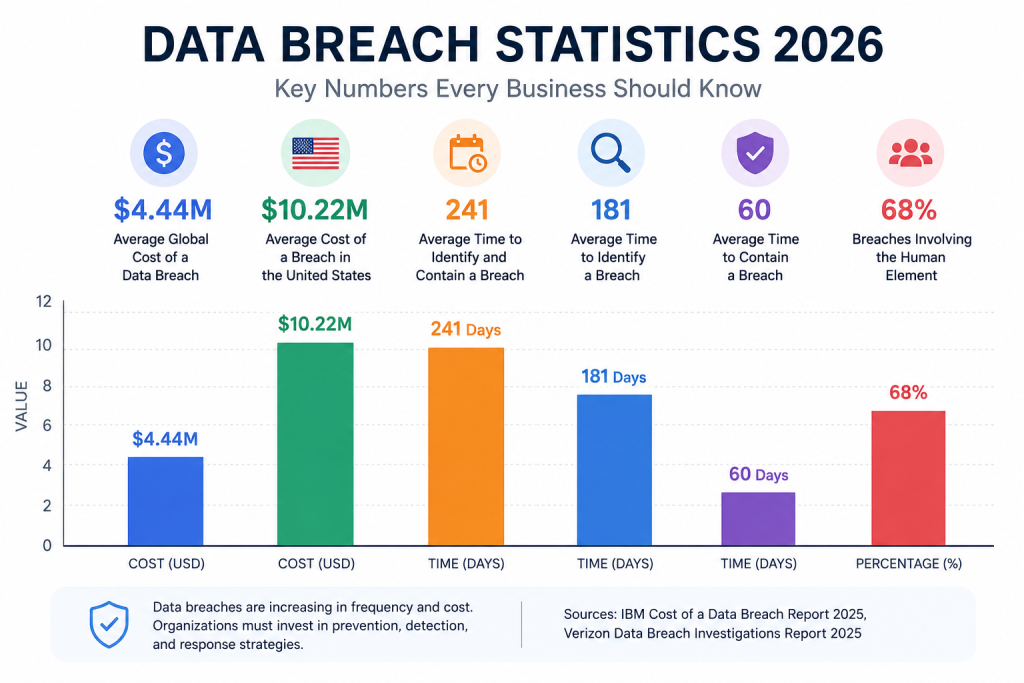
Data Breach Statistics at a Glance
| Metric | Latest Statistic |
|---|---|
| Global average cost of a data breach | USD 4.44 million |
| Average cost of a breach in the United States | USD 10.22 million |
| Average time to identify and contain a breach | 241 days |
| Average time to identify a breach | 181 days |
| Average time to contain a breach | 60 days |
| Security incidents analyzed | 22,000+ |
| Confirmed data breaches analyzed | 12,000+ |
| Breaches involving a human element | 68% |
| Organizations increasing cybersecurity spending after a breach | 49% |
| Average cost per compromised record | USD 160 |
The Average Data Breach Costs Millions
The average global data breach now costs USD 4.44 million, making cybersecurity one of the largest operational risks for modern businesses.
These costs extend far beyond recovering stolen data. Organizations often face legal fees, regulatory penalties, system recovery expenses, customer compensation, business disruption, and long-term reputational damage.
For businesses operating in highly regulated industries such as healthcare and finance, the financial impact can be considerably higher.
Hackers Are More Patient Than Ever
Many people imagine hackers breaking into systems within minutes.
The reality is very different.
The average organization requires 181 days just to discover a breach, followed by another 60 days to fully contain it.
That means attackers often remain inside company networks for nearly eight months, quietly collecting sensitive information before being detected.
Small Businesses Are Not Safe
One of the biggest cybersecurity myths is that hackers only target large corporations.
In reality, small and medium-sized businesses are frequently attacked because they often have fewer security controls and limited cybersecurity resources.
Many ransomware groups now deliberately target smaller organizations, assuming they are more likely to pay to restore business operations quickly.
Cloud Adoption Brings New Security Challenges
Cloud computing has transformed modern business, but it has also expanded the attack surface.
Organizations now manage applications, databases, customer information, and employee identities across multiple cloud platforms. Misconfigured storage, weak identity management, and third-party integrations continue to create opportunities for attackers.
Strong cloud governance, encryption, and continuous monitoring have become essential components of modern cybersecurity.
Artificial Intelligence Is Changing Cybersecurity
Artificial intelligence is now influencing both attackers and defenders.
Cybercriminals are using AI to generate more convincing phishing campaigns, automate reconnaissance, and accelerate malware development.
At the same time, businesses are deploying AI-powered security platforms capable of detecting suspicious behavior, identifying anomalies, and responding to threats much faster than traditional security tools.
This technological race is expected to define the next generation of cybersecurity.
Every Business Should Prepare for “When,” Not “If”
Perhaps the most important statistic isn’t measured in dollars or percentages.
It’s the growing consensus among cybersecurity professionals that every organization should assume it will eventually experience a security incident.
The businesses that recover fastest are not necessarily those with the largest cybersecurity budgets—they are the ones with well-tested incident response plans, regular employee training, reliable backups, and continuous security monitoring.
Preparation has become one of the strongest competitive advantages in today’s digital economy.
Five Cybersecurity Actions Every Organization Should Take
| Priority | Why It Matters |
| Enable Multi-Factor Authentication | Reduces the risk of compromised accounts |
| Train Employees Regularly | Helps prevent phishing and social engineering attacks |
| Encrypt Sensitive Data | Protects information if systems are compromised |
| Keep Software Updated | Eliminates known vulnerabilities attackers exploit |
| Develop an Incident Response Plan | Reduces recovery time and financial losses |
Final Thoughts
Data breach statistics reveal a clear trend: cyber threats are becoming more frequent, more expensive, and more sophisticated. While technology continues to evolve, attackers are adapting just as quickly, making cybersecurity an ongoing business priority rather than a one-time investment.
Organizations that combine advanced security technologies with employee education, proactive monitoring, and strong governance are far better equipped to protect sensitive information and maintain customer trust.