
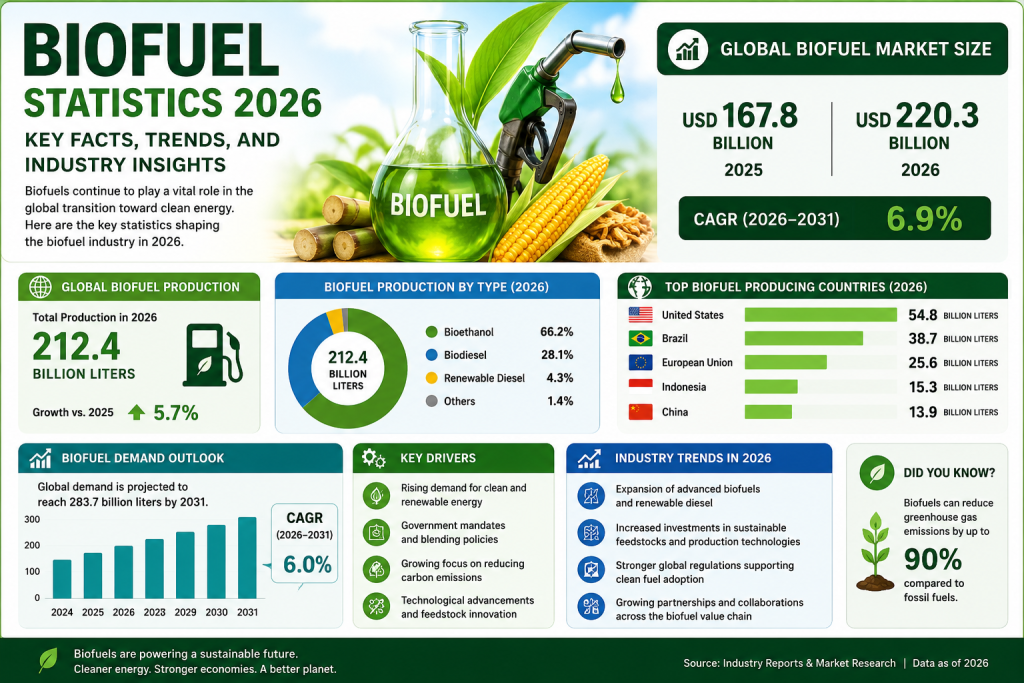

Biofuels have become one of the fastest-growing segments of the global renewable energy industry. As governments strengthen climate policies and transportation sectors seek lower-carbon alternatives, demand for biofuels continues to increase across road transport, aviation, shipping, and industrial applications. Ethanol, biodiesel, renewable diesel, sustainable aviation fuel (SAF), and advanced biofuels are all benefiting from supportive regulations and rising investment.
In 2026, the biofuel industry is experiencing strong momentum, driven by energy security concerns, decarbonization goals, and technological innovation. Countries worldwide are expanding blending mandates, investing in advanced feedstocks, and modernizing production facilities to meet future renewable fuel demand.
Biofuel Statistics 2026 at a Glance
| Statistic | 2026 Insight |
|---|---|
| Global bioenergy production (2024 latest available) | 51 exajoules (EJ) |
| Global bioenergy final consumption | 40 EJ |
| Liquid biofuels share of total bioenergy consumption | 4.8 EJ (12%) |
| Solid biofuels share | 35.5 EJ (88%) |
| Bioenergy growth since 1990 | Increased from 28 EJ to 51 EJ |
| Growth in liquid biofuel consumption since 1990 | Nearly 19-fold increase |
| Countries with liquid biofuel policies | More than 80 countries |
| Modern bioenergy share of global renewable energy | Around 55% |
| Modern bioenergy share of global energy supply | Over 6% |
| Expected share of renewable fuels in transport, buildings and industry by 2030 | Approximately 5.5% |
| Bioenergy share of renewable fuel growth to 2030 | About 95% |
| Major growth markets | China, India, Brazil, United States, Europe |
Global Biofuel Industry Continues to Expand
The global biofuel industry continues to benefit from government mandates, renewable fuel standards, and growing corporate sustainability commitments. Countries are increasingly blending ethanol and biodiesel with conventional fuels to reduce greenhouse gas emissions while improving domestic energy security.
Demand is particularly strong in transportation, where biofuels provide an immediate solution for lowering emissions from existing internal combustion engines. Heavy-duty trucking, marine transport, and aviation are also becoming major areas of opportunity, especially as sustainable aviation fuel production expands.
Ethanol Remains the Largest Biofuel Segment
Ethanol continues to dominate global biofuel production. Produced primarily from corn, sugarcane, and increasingly from agricultural residues, ethanol is widely blended with gasoline in many countries.
Several governments have increased ethanol blending targets over the past few years, encouraging investment in new production plants and advanced fermentation technologies. The continued expansion of ethanol supports agricultural economies while reducing dependence on imported petroleum.
Second-generation ethanol, produced from crop residues and non-food biomass, is also gaining commercial momentum as sustainability requirements become stricter.
Biodiesel and Renewable Diesel Gain Momentum
Biodiesel and renewable diesel remain essential components of the global renewable fuel industry. These fuels are increasingly used in commercial transportation, freight logistics, agriculture, and industrial machinery.
Growing demand for low-carbon diesel alternatives is encouraging investments in production capacity and feedstock diversification. Waste cooking oil, animal fats, and agricultural residues are becoming increasingly important feedstocks as producers seek more sustainable raw materials.
Sustainable Aviation Fuel Creates New Growth Opportunities
One of the fastest-growing areas within the biofuel industry is Sustainable Aviation Fuel (SAF). Airlines and governments are investing heavily in SAF to reduce emissions from one of the hardest-to-decarbonize transportation sectors.
Bio-based feedstocks remain the primary source of SAF production today, making biofuel producers key participants in the future aviation fuel market.
Policy Support Continues to Drive Market Growth
Government policies remain one of the strongest growth drivers for biofuels. Renewable fuel mandates, blending requirements, production incentives, and carbon reduction programs continue to encourage investment worldwide.
Countries including Brazil, India, the United States, China, and members of the European Union continue expanding renewable fuel programs to strengthen energy independence while supporting climate commitments.
Supportive regulations are also encouraging the commercialization of advanced biofuels produced from waste biomass and agricultural residues.
Technology Is Improving Biofuel Production
Digital technologies are transforming modern biofuel facilities. Artificial intelligence, automation, predictive maintenance, and advanced process controls help producers improve efficiency while reducing operational costs.
Carbon capture technologies are also becoming more common at ethanol plants, allowing producers to further reduce lifecycle emissions and improve sustainability performance.
Research into advanced enzymes, biomass conversion technologies, and feedstock optimization continues to improve production yields across the industry.
Outlook for 2026 and Beyond
The outlook for biofuels remains highly positive. Global energy diversification, rising investment in renewable fuels, expanding ethanol blending mandates, and growing demand for sustainable aviation fuel are expected to support long-term industry growth.
Although challenges such as feedstock availability, infrastructure investment, and production costs remain, continuous innovation is making biofuels increasingly competitive.
As governments pursue net-zero targets and industries transition toward cleaner energy systems, biofuels will continue to play a critical role in reducing transportation emissions, supporting rural economies, and strengthening global energy security. The combination of policy support, technological advancements, and expanding commercial applications positions biofuels as one of the most important renewable energy sectors of the coming decade.