
Germany has long been recognized as one of the world’s most influential automotive markets, home to legendary manufacturers that have shaped the future of mobility for decades. As the first half of 2026 comes to a close, the country’s latest vehicle registration figures reveal a familiar yet fascinating story—German brands continue to command consumer confidence, while changing buyer preferences, electrification, and technological innovation reshape the competitive landscape.
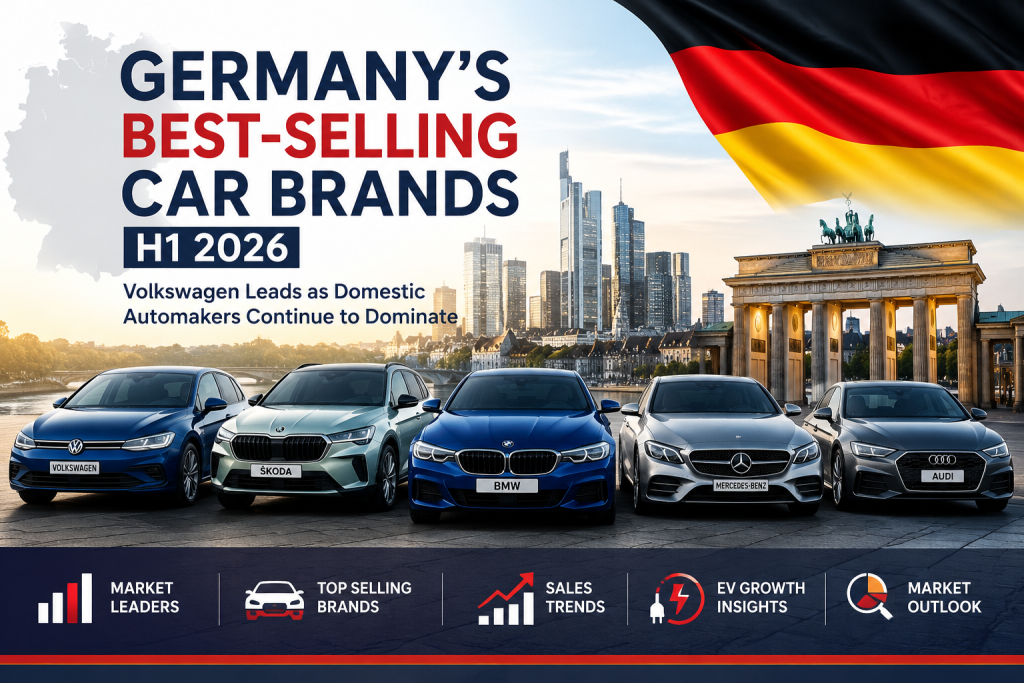
According to the latest H1 2026 vehicle registration data, Volkswagen retained its position as Germany’s best-selling car brand, followed by Škoda, BMW, Mercedes-Benz, and Audi. The rankings highlight the enduring strength of the Volkswagen Group while demonstrating that premium manufacturers remain highly competitive despite economic uncertainty and the industry’s transition toward electric mobility.
While the leaderboard appears stable at first glance, the forces driving these results are anything but ordinary. Behind every registration lies a combination of consumer confidence, technological advancement, pricing strategy, sustainability initiatives, and evolving mobility preferences.
Germany’s Top Five Car Brands in the First Half of 2026
| Rank | Brand | Position in H1 2026 |
|---|---|---|
| 1 | Volkswagen | Market Leader |
| 2 | Škoda | Strong Growth |
| 3 | BMW | Premium Segment Leader |
| 4 | Mercedes-Benz | Luxury Performance |
| 5 | Audi | Technology-Focused Competitor |
The rankings reinforce the dominance of manufacturers that have consistently invested in innovation, engineering excellence, and customer trust. While international brands continue expanding their footprint across Europe, domestic manufacturers remain exceptionally well positioned within their home market.
Volkswagen Continues to Set the Pace
Maintaining leadership in one of the world’s most competitive automotive markets is no small achievement. Volkswagen’s continued success reflects decades of brand loyalty combined with an ability to adapt to rapidly changing market conditions.
Consumers increasingly expect vehicles that combine efficiency, connectivity, advanced safety systems, and digital experiences without compromising reliability. Volkswagen has responded by expanding its portfolio across traditional combustion vehicles, hybrids, and fully electric models, allowing the company to appeal to a wide range of buyers.
Its extensive dealership network, strong after-sales service, and broad model lineup—from compact city cars to family SUVs—continue to make Volkswagen the first choice for many German households.
Škoda’s Remarkable Rise
Perhaps one of the most interesting developments in recent years has been Škoda’s consistent rise within the German market.
Once viewed primarily as a budget alternative, the brand has successfully repositioned itself by offering vehicles that combine premium features with competitive pricing. Consumers are increasingly recognizing Škoda for its spacious interiors, practical design, advanced technology, and impressive value proposition.
As inflation and cost-conscious purchasing continue influencing buying decisions, Škoda has become an attractive option for families and professionals seeking quality without paying luxury-brand prices.
Its performance in the first half of 2026 demonstrates that value-driven innovation remains a powerful competitive advantage.
BMW Continues to Blend Luxury with Performance
BMW maintained its position among Germany’s top-selling car brands by successfully combining premium engineering with technological innovation. The company’s diverse portfolio, ranging from sporty sedans and luxury SUVs to its expanding lineup of electric vehicles, continues to attract buyers seeking performance without compromising comfort or sustainability. BMW has also strengthened its appeal through intelligent driver assistance systems, connected mobility services, and continuous investments in electrification. As demand grows for vehicles that offer both dynamic driving experiences and advanced digital features, BMW remains well positioned to compete in Germany’s evolving automotive landscape.
Mercedes-Benz Reinforces Its Premium Legacy
Mercedes-Benz continues to be one of Germany’s most trusted luxury automotive brands, recognized for its commitment to innovation, safety, and refined craftsmanship. The manufacturer has accelerated its transition toward sustainable mobility by expanding its electric and hybrid offerings while integrating cutting-edge technologies such as AI-powered infotainment systems, advanced driver assistance features, and connected vehicle services. Its ability to combine timeless design with next-generation technology has helped Mercedes-Benz retain a loyal customer base while attracting a new generation of buyers seeking premium, intelligent, and environmentally conscious mobility solutions.
Premium Brands Continue to Thrive
Despite economic pressures affecting consumers across Europe, Germany’s premium automotive segment remains remarkably resilient.
BMW, Mercedes-Benz, and Audi continue attracting buyers who prioritize performance, engineering precision, luxury, and cutting-edge technology. Modern premium vehicles now offer far more than refined interiors—they serve as connected digital platforms equipped with artificial intelligence, advanced driver assistance systems, over-the-air software updates, and increasingly sophisticated infotainment experiences.
This evolution has transformed luxury vehicles into technology products as much as transportation solutions.
For many buyers, purchasing a premium vehicle is no longer solely about prestige. It is about accessing innovative safety features, superior driving dynamics, enhanced comfort, and long-term ownership value.
Electrification Is Reshaping Consumer Choices
One of the most influential trends shaping Germany’s automotive industry is the continued shift toward electrified mobility.
Electric vehicles and plug-in hybrids are steadily gaining popularity as governments promote cleaner transportation, charging infrastructure expands, and manufacturers introduce new models with improved battery range and shorter charging times.
At the same time, advances in battery technology are reducing range anxiety while making electric vehicles increasingly practical for both urban commuters and long-distance drivers.
Rather than replacing conventional vehicles overnight, electrification is creating a more diverse marketplace where consumers can choose from multiple powertrain options based on their lifestyle, driving habits, and budget.