
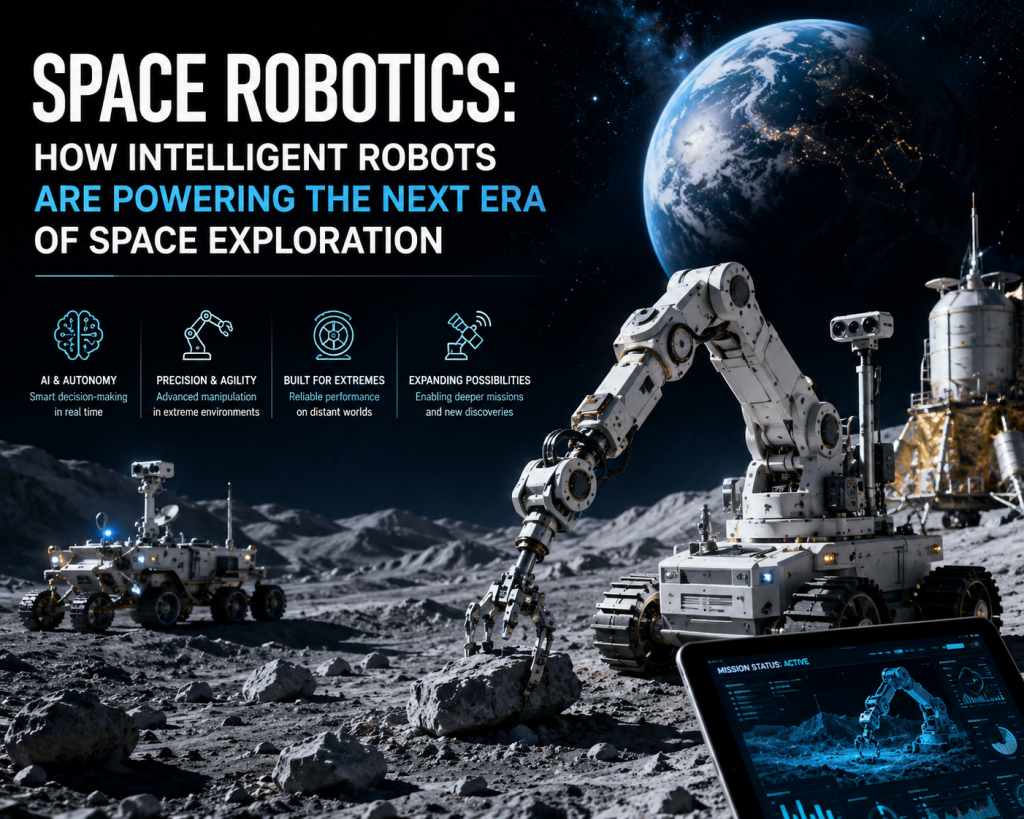

Space exploration is entering a new era where intelligent robotic systems are becoming as important as rockets and satellites. From exploring distant planets and repairing satellites in orbit to assisting astronauts aboard space stations, Space Robotics is revolutionizing how missions are planned and executed. Governments, private space companies, and research organizations are investing heavily in advanced robotic technologies to make space missions safer, more efficient, and more cost-effective.
Modern space robots combine artificial intelligence (AI), machine learning, computer vision, autonomous navigation, and precision engineering to perform complex tasks in environments that are too dangerous or inaccessible for humans. As global interest in lunar exploration, Mars missions, asteroid mining, and commercial space activities continues to grow, space robotics is becoming one of the fastest-evolving sectors within the aerospace industry.
With agencies such as NASA, ESA, ISRO, JAXA, and leading private companies accelerating investments in robotic exploration, the future of space missions will increasingly depend on intelligent autonomous systems.
Key Highlights
- Space robotics is transforming satellite servicing, planetary exploration, and deep-space missions.
- Artificial Intelligence is enabling robots to make autonomous decisions in space.
- Lunar and Mars exploration programs are driving demand for robotic technologies.
- Commercial space companies are investing in robotic satellite maintenance and orbital operations.
- Autonomous rovers continue expanding scientific research on planetary surfaces.
- Robotic arms remain essential for space station operations and satellite deployment.
- Machine learning and computer vision are improving robotic navigation in space.
- Space robotics is becoming a critical component of the rapidly growing global space economy.
10 Space Robotics Statistics You Should Know
- Space agencies worldwide continue increasing investments in robotic exploration.
- Commercial satellite launches are growing every year.
- Autonomous robotic systems are becoming central to lunar exploration missions.
- Satellite servicing technologies are extending the operational life of spacecraft.
- Artificial Intelligence is improving robotic autonomy during deep-space missions.
- Planetary rovers continue collecting valuable scientific information from distant worlds.
- Robotics significantly reduce operational risks during complex space missions.
- Commercial space activities are driving demand for intelligent robotic systems.
- Next-generation robotic technologies are enabling more ambitious space exploration projects.
- The global space economy continues creating new opportunities for robotics manufacturers.
What Is Space Robotics?
Space robotics refers to robotic systems specifically designed to operate in the harsh environment of outer space.
These systems perform tasks such as:
- Planetary exploration
- Satellite servicing
- Space station maintenance
- Cargo transportation
- Scientific research
- Equipment installation
- Orbital inspection
- Autonomous navigation
Unlike conventional robots, space robots must operate in extreme temperatures, radiation, microgravity, and vacuum conditions while maintaining exceptional reliability.
How Space Robotics Works
Modern space robotics combines multiple advanced technologies to perform highly complex missions.
Artificial Intelligence
AI enables robots to analyze environments, make decisions, recognize objects, and complete missions with limited human intervention.
Applications include:
- Autonomous navigation
- Mission planning
- Hazard detection
- Scientific analysis
Machine Learning
Machine learning allows robots to improve performance by learning from previous operations and mission data.
Computer Vision
Advanced imaging systems help robots identify terrain, obstacles, equipment, and mission targets.
Autonomous Navigation
Robotic systems can independently calculate routes and avoid hazards while exploring unfamiliar environments.
Why Space Robotics Is Growing
Governments and private organizations increasingly rely on robotics for ambitious space missions.
Expansion of Lunar Missions
Multiple countries are planning long-term lunar exploration and infrastructure projects that require autonomous robotic systems.
Mars Exploration
Robotic explorers continue serving as the first step toward future human missions to Mars.
Commercial Space Growth
Private companies are investing in:
- Satellite servicing
- Orbital manufacturing
- Space tourism
- Cargo transportation
These activities require advanced robotic technologies.
Satellite Maintenance
Robotic servicing can inspect, repair, refuel, and extend satellite lifespans, reducing operational costs.
Industry Applications
Planetary Exploration
Autonomous rovers explore planetary surfaces by collecting samples, analyzing rocks, and searching for signs of water or life.
Space Stations
Robotic arms assist astronauts by moving equipment, conducting maintenance, and supporting scientific experiments.
Satellite Servicing
Robots inspect damaged satellites, replace components, and perform maintenance in orbit.
Space Manufacturing
Future robotic systems may construct large spacecraft and infrastructure directly in space.
Deep-Space Exploration
Autonomous spacecraft equipped with robotic technologies can explore distant planets, moons, and asteroids without continuous human control.
Space Robotics vs Human Exploration
Human astronauts remain essential for many missions.
However, robotics offers several advantages.
Space robots can:
- Operate continuously
- Withstand hazardous environments
- Perform repetitive tasks
- Reduce mission risks
- Lower operational costs
- Reach distant destinations before humans
The future of exploration will likely involve close collaboration between astronauts and intelligent robotic systems.
Benefits of Space Robotics
Organizations investing in space robotics gain several advantages.
Improved Mission Safety
Robots perform dangerous tasks before astronauts arrive.
Lower Costs
Autonomous operations reduce mission expenses over time.
Increased Scientific Discovery
Robots can operate for years while continuously collecting valuable scientific data.
Operational Efficiency
Autonomous systems complete complex missions with minimal human supervision.
Challenges Facing Space Robotics
Despite remarkable progress, several challenges remain.
Extreme Space Conditions
Robots must survive radiation, vacuum environments, and significant temperature fluctuations.
Communication Delays
Deep-space missions require autonomous decision-making because communication with Earth may take several minutes or hours.
High Development Costs
Designing reliable robotic systems requires substantial research, testing, and engineering.
Limited Repair Opportunities
Most space robots cannot be repaired after launch, making reliability essential.
Emerging Trends
Several innovations are expected to shape the future of space robotics.
- AI-powered autonomous spacecraft
- Robotic satellite servicing
- Lunar construction robots
- Swarm robotics
- Asteroid mining robots
- Space manufacturing systems
- Human-robot collaboration
- Intelligent robotic assistants for astronauts
These technologies are expected to expand the capabilities of future space missions.
Future Outlook
The future of space robotics appears exceptionally promising.
Industry experts expect:
- Increased commercial investment in robotic space technologies
- Expansion of lunar infrastructure projects
- More advanced Mars exploration missions
- AI-driven autonomous spacecraft
- Growth of orbital servicing and maintenance
- Robotic systems supporting deep-space exploration
As humanity expands beyond Earth, robotics will remain one of the most important technologies enabling sustainable exploration and long-term space development.
Conclusion
Space Robotics has become one of the most exciting and strategically important fields in the global aerospace industry. Intelligent robotic systems are transforming satellite servicing, planetary exploration, space station operations, and deep-space research through advances in Artificial Intelligence, machine learning, and autonomous navigation.
As governments and private companies continue investing in ambitious space programs, robotics will play a central role in unlocking new scientific discoveries, reducing mission risks, and enabling sustainable exploration beyond Earth’s orbit. The next generation of space missions will not rely solely on astronauts—they will be powered by intelligent robots working alongside humans to explore the final frontier.