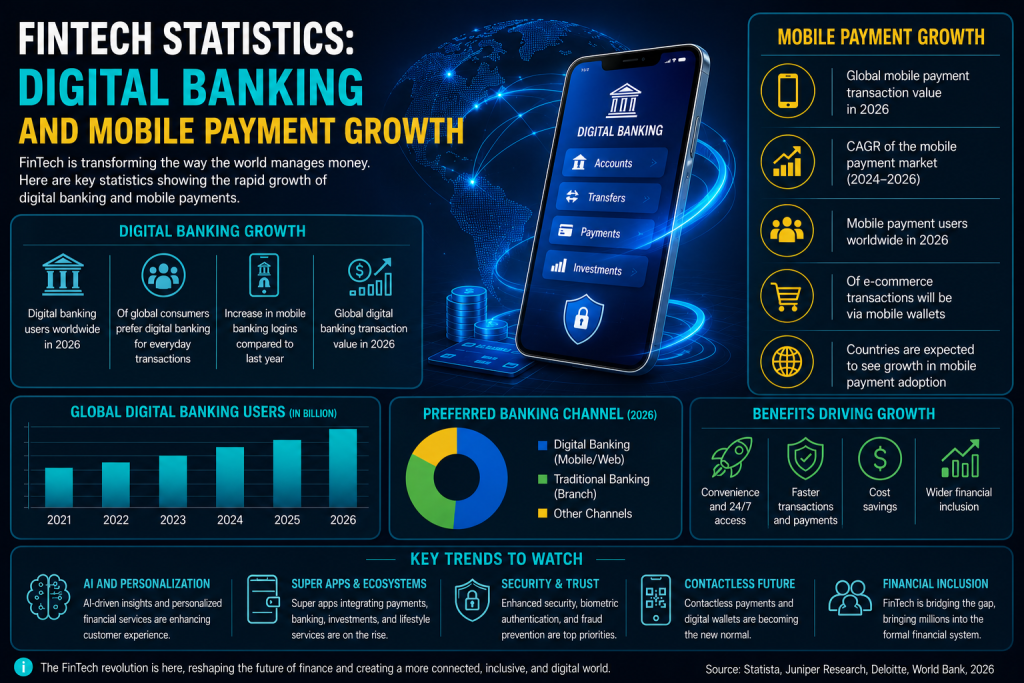

The financial technology (FinTech) industry has transformed the way individuals and businesses manage money. From digital banking apps to mobile payment platforms, technology has made financial services faster, more convenient, and more accessible than ever before. In 2026, the FinTech sector continues to experience strong growth as consumers increasingly prefer cashless transactions, online banking, and digital wallets over traditional banking methods.
Several factors are driving this growth, including widespread smartphone adoption, expanding internet access, advancements in artificial intelligence (AI), and increasing investments in digital financial infrastructure. Governments and financial institutions are also promoting digital payments to improve financial inclusion and create more efficient economies.
Key FinTech Statistics
| Metric | Statistic (2026) |
|---|---|
| Global FinTech Market Size | USD 340+ Billion |
| Expected Market CAGR | 15–20% |
| Digital Banking Users | 2.5+ Billion |
| Mobile Payment Users | 3+ Billion |
| Digital Wallet Share of E-commerce Payments | 50%+ |
| Adults Using Digital Banking | 70%+ |
| Businesses Accepting Digital Payments | 80%+ |
| AI Adoption in Financial Services | 60%+ |
| Contactless Payment Adoption | 80%+ (Developed Markets) |
| FinTech Startups Worldwide | 35,000+ |
Digital Banking Is Becoming the New Standard
Digital banking has become the preferred choice for millions of consumers worldwide. Customers now expect to check account balances, transfer money, pay bills, apply for loans, and manage investments directly from their smartphones or computers. Banks are investing heavily in cloud computing, AI-powered customer service, and mobile applications to deliver faster and more personalized financial experiences.
The rise of digital-only banks has further accelerated this transformation by offering convenient services without the need for physical branches. As consumers become more comfortable with online financial services, digital banking adoption continues to rise across both developed and emerging economies.
Mobile Payments Continue to Grow
Mobile payment platforms have changed how people shop, pay bills, and transfer money. Digital wallets, QR code payments, contactless cards, and peer-to-peer payment apps are replacing cash for everyday transactions. Consumers appreciate the speed, convenience, and security these payment methods provide.
Businesses are also embracing mobile payments because they simplify transactions, reduce cash handling, and improve customer satisfaction. With smartphone usage continuing to increase globally, mobile payment adoption is expected to grow even further in the coming years.
Artificial Intelligence Is Reshaping Financial Services
Artificial intelligence has become one of the biggest drivers of innovation in the FinTech industry. Banks and financial institutions use AI to detect fraud, automate customer support, assess credit risk, and provide personalized financial recommendations.
AI-powered chatbots help customers receive instant assistance, while machine learning algorithms analyze transaction patterns to identify suspicious activities. These technologies improve efficiency while enhancing security and customer experience.
Financial Inclusion Is Expanding
One of the greatest benefits of FinTech is its ability to improve financial inclusion. Digital banking services allow people in remote and underserved areas to access banking services using only a smartphone and internet connection.
Mobile payment platforms, digital savings accounts, and online lending services help individuals and small businesses participate in the formal financial system without depending on traditional banking infrastructure. This creates new economic opportunities and supports inclusive growth.
Cybersecurity Remains a Top Priority
As digital financial services expand, protecting customer information becomes increasingly important. Financial institutions continue investing in encryption technologies, biometric authentication, multi-factor authentication, and AI-powered fraud detection systems.
Strong cybersecurity measures help maintain customer trust while protecting sensitive financial data from cyber threats. Continuous investment in digital security is essential as online transactions continue to increase.
The Future of FinTech
The future of FinTech looks promising as new technologies continue to transform financial services. Artificial intelligence, blockchain, embedded finance, open banking, and real-time payment systems are expected to drive the next wave of innovation.
Consumers will benefit from faster, safer, and more personalized financial services, while businesses will gain access to smarter payment solutions and advanced financial analytics. As governments and financial institutions continue investing in digital infrastructure, the FinTech industry is expected to remain one of the fastest-growing sectors of the global economy.
Conclusion
FinTech is revolutionizing the financial industry by making banking and payments more accessible, secure, and efficient. The continued growth of digital banking and mobile payments reflects changing consumer preferences and rapid technological advancement. As innovation continues, the FinTech sector will play an increasingly important role in shaping the future of global finance, improving financial inclusion, and driving economic growth.