
Just two decades ago, online shopping was largely limited to purchasing books, electronics, and a handful of consumer goods through desktop computers. Today, it has become one of the world’s largest industries, transforming how consumers discover products, compare prices, make purchases, and interact with brands.
From mobile commerce and digital wallets to AI-powered product recommendations and same-day delivery, online shopping has become an essential part of everyday life. Consumers now expect seamless digital experiences across websites, mobile apps, and social commerce platforms.
The latest online shopping statistics for 2026 demonstrate how rapidly digital commerce continues to expand. The numbers highlight a global marketplace driven by convenience, technology, and changing consumer preferences.
The Continued Growth of Online Shopping
Online shopping continues to experience strong growth across both developed and emerging markets. Increased internet penetration, widespread smartphone usage, secure digital payment systems, and faster logistics networks are encouraging consumers to shop online more frequently.
The COVID-19 pandemic accelerated e-commerce adoption, and consumer habits formed during that period have largely remained. Today, online shopping is no longer viewed as an alternative to physical retail—it has become the preferred shopping method for millions of consumers worldwide.
Businesses of all sizes are investing in digital storefronts, omnichannel retail strategies, and AI-powered customer experiences to remain competitive in an increasingly digital marketplace.
Global Online Shopping Snapshot
The numbers illustrate the remarkable scale of online shopping in 2026.
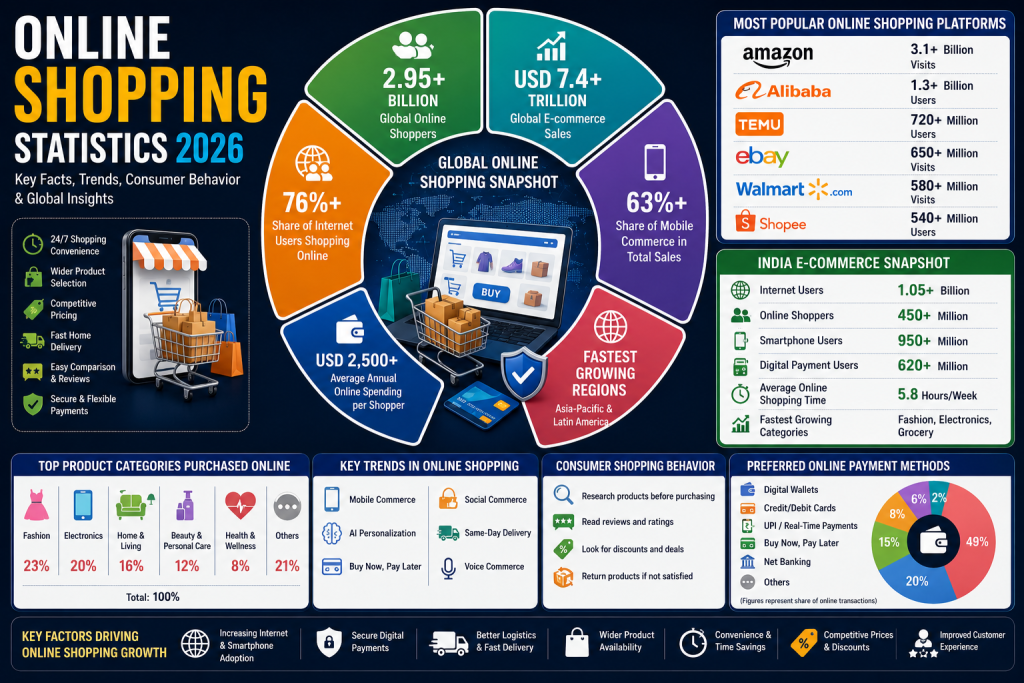
| Metric | 2026 Estimate |
|---|---|
| Global Online Shoppers | 2.95+ Billion |
| Share of Internet Users Shopping Online | 76%+ |
| Global E-commerce Sales | USD 7.4+ Trillion |
| Average Annual Online Spending per Shopper | USD 2,500+ |
| Mobile Commerce Share | 63%+ |
| Fastest Growing Regions | Asia-Pacific & Latin America |
These figures show that online shopping has become a mainstream consumer activity, with billions of people making digital purchases every year.
The Most Popular Online Shopping Platforms
Several e-commerce platforms continue to dominate global online retail.
| Platform | Estimated Monthly Active Users |
|---|---|
| Amazon | 3.1+ Billion Visits |
| Alibaba (Taobao & Tmall) | 1.3+ Billion Users |
| Temu | 720+ Million Users |
| eBay | 650+ Million Visits |
| Walmart.com | 580+ Million Visits |
| Shopee | 540+ Million Users |
While established marketplaces continue to lead global e-commerce, regional platforms are expanding rapidly through competitive pricing, faster delivery, and localized shopping experiences.
Why Consumers Prefer Online Shopping
The popularity of online shopping is driven by several factors that improve convenience and enhance the customer experience.
Consumers increasingly choose online shopping for:
- 24/7 shopping convenience
- Wider product selection
- Competitive pricing
- Faster home delivery
- Easy product comparisons
- Customer reviews and ratings
- Flexible payment options
- Personalized recommendations
Online shopping has evolved beyond simple purchasing. Today, consumers use digital platforms for product discovery, price tracking, brand engagement, and post-purchase support.
India Continues to Be a Fast-Growing E-commerce Market
India remains one of the fastest-growing online shopping markets globally.
The country has approximately:
| India E-commerce Statistics | 2026 Data |
|---|---|
| Internet Users | 1.05+ Billion |
| Online Shoppers | 450+ Million |
| Smartphone Users | 950+ Million |
| Digital Payment Users | 620+ Million |
| Average Online Shopping Time | 5.8 Hours/Week |
| Fastest Growing Categories | Fashion, Electronics, Grocery |
Affordable smartphones, UPI-based digital payments, rapid logistics expansion, and growing consumer confidence continue to fuel India’s e-commerce growth.
Mobile Shopping Is Dominating Online Retail
One of the biggest trends shaping online shopping in 2026 is the rapid growth of mobile commerce (m-commerce).
Consumers increasingly prefer shopping through smartphones because mobile apps provide:
- Faster checkout experiences
- AI-powered product recommendations
- Personalized discounts
- One-click payments
- Real-time order tracking
Retailers continue investing heavily in mobile applications as smartphone purchases account for the majority of online transactions worldwide.
Artificial Intelligence Is Transforming Online Shopping
Artificial Intelligence has become one of the biggest drivers of digital commerce.
Retailers are using AI to:
- Deliver personalized product recommendations
- Improve search accuracy
- Automate customer support
- Forecast inventory demand
- Optimize pricing strategies
- Detect payment fraud
AI-powered shopping assistants and generative AI tools are making online shopping more personalized and efficient than ever before.
Key Trends Defining Online Shopping in 2026
Several major trends are reshaping the future of e-commerce.
| Trend | Why It Matters |
|---|---|
| Mobile Commerce | Majority of purchases occur on smartphones |
| AI Personalization | Improves shopping experience and conversions |
| Buy Now, Pay Later (BNPL) | Flexible payment options boost purchases |
| Social Commerce | Shopping through social media platforms |
| Same-Day Delivery | Faster fulfillment improves customer satisfaction |
| Voice Commerce | Smart assistants simplify product searches |
These innovations are helping retailers improve customer experiences while increasing sales and operational efficiency.
Challenges Facing Online Shopping
Despite continued growth, online shopping still faces several challenges.
Cybersecurity remains a major concern as businesses work to protect customer data and payment information. Rising logistics costs and supply chain disruptions continue to impact delivery performance.
Counterfeit products remain a challenge across some online marketplaces, while increasing competition makes customer acquisition more expensive.
Retailers must also balance fast delivery expectations with sustainability goals, as consumers increasingly demand environmentally responsible packaging and shipping practices.
What Does the Future Look Like?
Industry experts expect online shopping to continue expanding rapidly over the coming years.
Artificial intelligence will further personalize shopping experiences through predictive recommendations and virtual shopping assistants. Augmented Reality (AR) and Virtual Reality (VR) are expected to improve online product visualization, allowing consumers to experience products before making purchases.
Drone delivery, autonomous logistics, and smart warehouses will continue improving fulfillment speed, while cross-border e-commerce will create new opportunities for businesses to reach global customers.
Social commerce, live shopping, and creator-driven retail are also expected to become increasingly important sales channels.
Final Thoughts
The statistics make one thing clear: online shopping has become one of the world’s most influential consumer industries.
With nearly 3 billion online shoppers, more than USD 7 trillion in global e-commerce sales, and continued innovation in AI, mobile commerce, and digital payments, online shopping continues to reshape global retail.
For retailers, brands, investors, and technology providers, understanding these trends is essential. As consumer expectations continue evolving and digital technologies advance, online shopping will remain at the center of the global retail ecosystem for years to come.