
In today’s digital world, a cyberattack is no longer a question of “if” but “when.” From multinational corporations and government agencies to small businesses and individual users, no one is completely immune to cyber threats. Every online transaction, cloud application, connected device, and digital service creates opportunities not only for innovation but also for cybercriminals looking to exploit vulnerabilities.
Over the past few years, cyberattacks have become more frequent, more sophisticated, and significantly more expensive. What was once limited to computer viruses has evolved into ransomware attacks, phishing campaigns, AI-powered scams, supply chain breaches, and attacks targeting critical infrastructure. As organizations continue their digital transformation journeys, cybersecurity has become one of the most important business priorities worldwide.
Cyberattack statistics help us understand how rapidly the threat landscape is changing. They reveal which industries are being targeted most often, how attackers are adapting their strategies, and why businesses are investing billions of dollars in cybersecurity solutions.
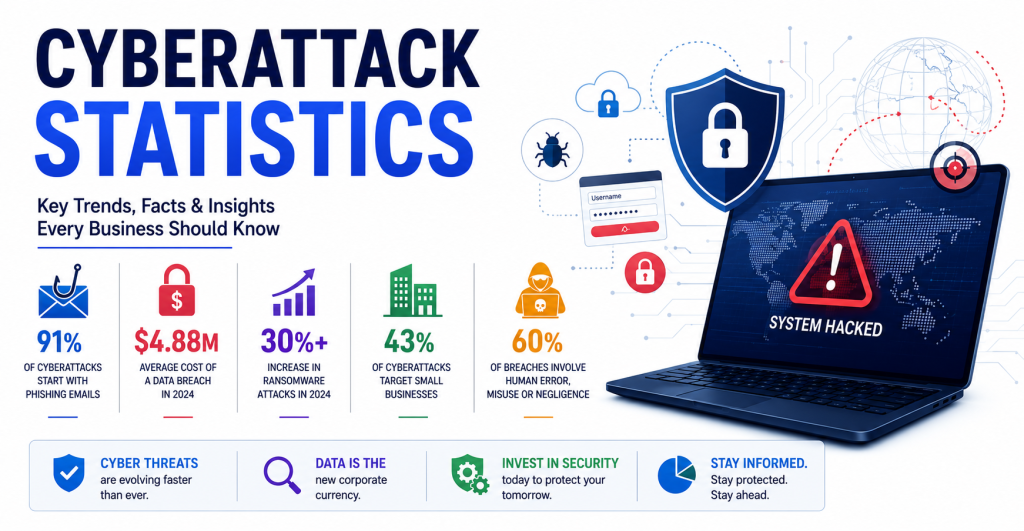
Cyberattack Statistics at a Glance
The numbers paint a clear picture of how cyber threats are evolving across industries.
| Cyberattack Statistic | Key Insight |
|---|---|
| Phishing remains one of the most common attack methods | Email-based attacks continue to target businesses and individuals worldwide. |
| Ransomware attacks continue to increase globally | Organizations across healthcare, finance, manufacturing, and education remain primary targets. |
| Human error remains a leading cause of security incidents | Weak passwords, accidental clicks, and poor security practices contribute significantly to breaches. |
| Small and medium-sized businesses face growing risks | Limited cybersecurity resources make smaller organizations attractive targets. |
| AI is transforming both cyberattacks and cybersecurity | Artificial intelligence is helping attackers automate threats while also strengthening cyber defense systems. |
These trends show that cyberattacks are no longer isolated incidents. They have become an ongoing challenge affecting organizations of every size.
Why Cyberattacks Are Increasing
The rapid growth of digital technologies has created countless opportunities for businesses, but it has also expanded the attack surface available to cybercriminals.
Today, organizations rely on cloud computing, remote work, mobile applications, connected devices, and digital payment systems to operate efficiently. Every connected system introduces another potential entry point for attackers.
At the same time, cybercriminals have become far more organized. Many operate like professional businesses, offering ransomware-as-a-service, phishing kits, and hacking tools through underground marketplaces. This has lowered the barrier to entry for cybercrime and increased the number of attacks worldwide.
Artificial intelligence is adding another layer to this evolution. Attackers now use AI to generate convincing phishing emails, automate malware, and identify vulnerabilities more quickly than ever before. As technology advances, cyber threats continue to evolve alongside it.
Phishing Continues to Be the Biggest Threat
When people think about cyberattacks, they often imagine highly skilled hackers breaking into complex computer systems.
In reality, many attacks begin with something much simpler a deceptive email.
Phishing remains one of the most effective attack methods because it targets human behavior rather than technology. Employees may unknowingly click on malicious links, download infected attachments, or share sensitive login credentials after receiving emails that appear legitimate.
Modern phishing campaigns have become remarkably sophisticated. Attackers now personalize messages using publicly available information, making fraudulent emails appear more authentic.
Businesses continue investing in employee awareness training because even the strongest cybersecurity software cannot prevent every human mistake.
Ransomware Is Becoming More Costly
Ransomware has evolved into one of the most damaging forms of cybercrime.
Instead of simply stealing information, attackers encrypt an organization’s files and demand payment before restoring access.
The financial impact extends far beyond the ransom itself.
Businesses often experience operational downtime, reputational damage, legal expenses, regulatory investigations, and lost customer trust. In many cases, recovery costs significantly exceed the ransom demand.
Healthcare organizations, manufacturing companies, educational institutions, and government agencies remain among the most frequently targeted sectors because service disruptions create enormous pressure to restore operations quickly.
Which Industries Face the Greatest Risk?
Although every organization faces cybersecurity challenges, some industries attract attackers more frequently due to the value of the data they handle.
| Industry | Why It Is Frequently Targeted |
| Healthcare | Stores sensitive patient records and critical medical systems. |
| Financial Services | Manages valuable financial transactions and customer information. |
| Government | Holds confidential national and citizen data. |
| Manufacturing | Increasing reliance on connected industrial systems creates new vulnerabilities. |
| Retail & E-commerce | Processes millions of customer payments and personal details. |
| Education | Large user bases and valuable research data make institutions attractive targets. |
As organizations continue adopting digital technologies, these industries are expected to remain key targets for cybercriminals.
Human Error Still Plays a Major Role
Despite significant advancements in cybersecurity technologies, people remain one of the weakest links in digital security.
Weak passwords, reused login credentials, delayed software updates, accidental downloads, and poor security awareness continue contributing to successful attacks.
Many organizations now recognize that cybersecurity is not solely an IT responsibility.
Employees across every department require regular cybersecurity training to identify suspicious emails, secure sensitive information, and respond appropriately to potential threats.
Creating a strong security culture has become just as important as investing in advanced cybersecurity software.
Cybersecurity Spending Continues to Grow
As cyber risks increase, businesses are responding by investing heavily in cybersecurity.
Organizations are expanding budgets for cloud security, endpoint protection, threat intelligence, identity management, multi-factor authentication, and AI-powered security platforms.
Rather than viewing cybersecurity as an operational expense, many executives now consider it a long-term business investment that protects customer trust, regulatory compliance, and organizational resilience.
This growing demand is also creating significant opportunities for cybersecurity companies, managed security providers, cloud security specialists, and artificial intelligence startups developing next-generation defense solutions.